
- Tips
- technology
- Frequently Asked Questions
- Tests
- mAh capacity
- Rated Capacity
- comparison
- everActive
- Batteries vs rechargeable batteries
- Accumulated energy
- Durability of rechargeable batteries
- Efficiency of rechargeable batteries
- battery voltage
- LR03 AAA
- LR6 AA
- eneloop
- AG13 LR1154 LR44
- CR 2032
- Delta V
- Charge Cycles
- internal resistance
- charge level
- memory effect
- accredited test
- SR44 357
- Hearing Batteries 675
- SR626 377
- Watch Batteries
- Polarity
- Mah
- passivation
- LS 14250
- LS 14500
The Secret Life of Household Devices, Part 1



Do you know how your toys, meters, cameras, chargers, flashlights, etc. actually work - what they do with batteries, rechargeable batteries, whether they operate safely and according to accepted standards?
Are your rechargeable batteries completely safe when left in your favorite toy or other device for an extended period?
What everyday problems might we encounter when using portable energy sources?
We invite you to read the post - the pilot of our latest series on the safety and usability of products that use batteries and rechargeable batteries.
The motivation to start a new series of posts was an unusual complaint, in which one of our customers returned a significant number of branded 9V rechargeable batteries, specifically Ni-MH with a nominal voltage of 8.4V. The batteries were used as a power backup in popular sensors, carbon monoxide and gas detectors.
Thanks to the courtesy of our customer, we also received a device for testing that worked with the advertised batteries.
Similar detectors are sold under various brands, but here we were dealing with an unspecified detector of unknown brand.
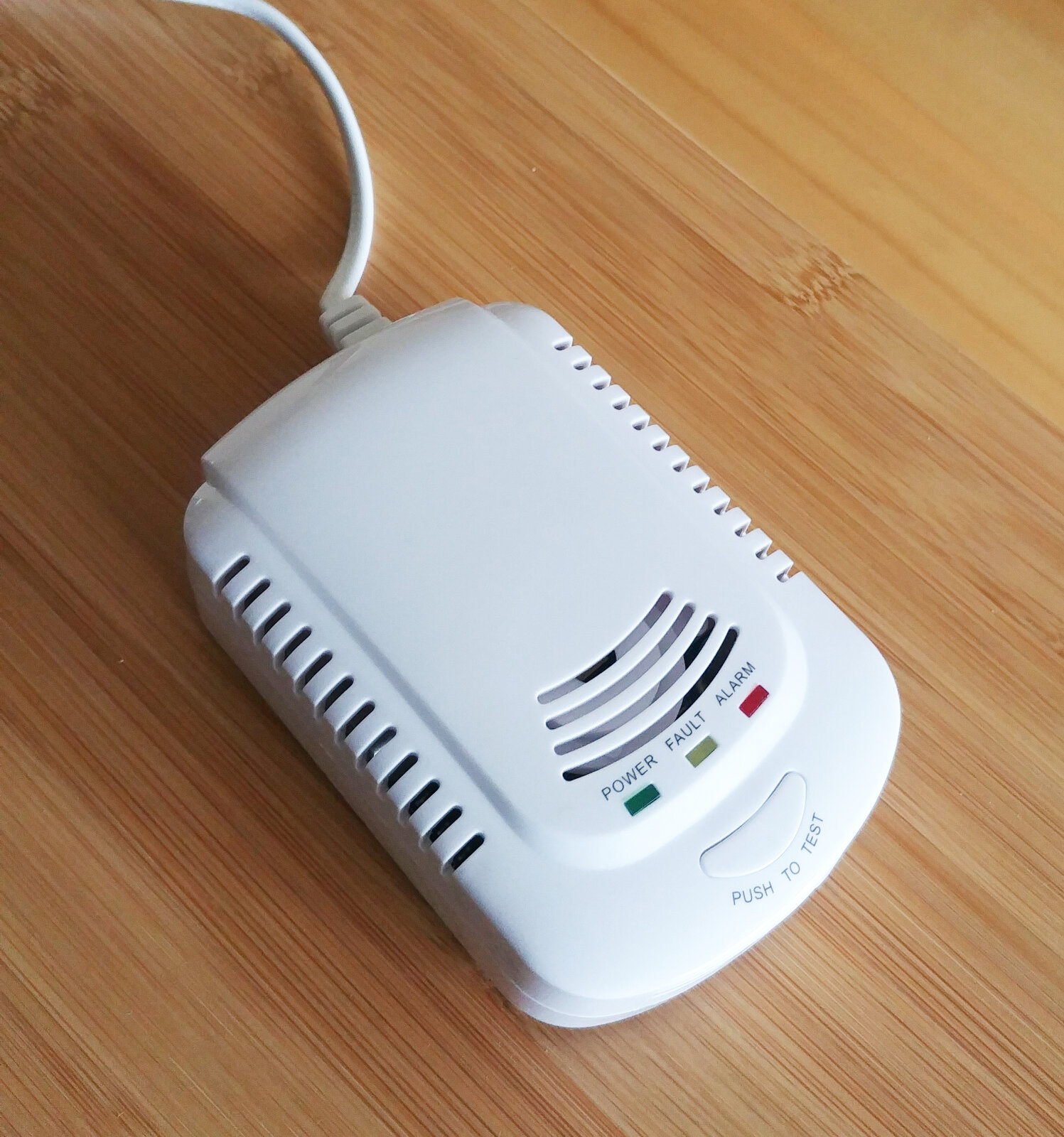
The device is powered directly from the AC mains, but in the event of a power failure, it is possible to maintain its operation using a 9V battery. The device has a built-in charger for 9V batteries. Unfortunately, the instructions lacked information on which specific type of battery should be used. Currently, the most popular are Ni-MH 8.4V batteries, but similar batteries with a voltage of 7.2V and even 9.6V can still be found on the market. In addition to Ni-MH batteries, Li-ion 7.4V batteries can also be encountered.
A typical, most popular type of battery was used for testing - Ni-MH 8.4V, with a nominal capacity of 200 mAh. We connected our measuring equipment to the detector to monitor how the detector charges and discharges the battery.
1. Charging the battery.
The previously discharged battery was installed in the detector. The detector was connected to the power supply.
The battery was left in the device for just over 24 hours.
We didn't have to wait long for the first significant problem - the detector never stops charging the installed battery!
The battery was fully charged after about 4 hours. Unfortunately, the charging did not stop after this time.
After 26 hours, the detector had "pumped" over 800 mAh into the 200 mAh battery, and yet the charging continued! One day was enough to repeatedly overcharge the battery. Under such conditions, any battery can be permanently damaged after just a few days. In extreme cases, it may lead to leakage, deformation, or even explosion of the battery in this device!

2. Discharging the battery.
This time, a fully charged battery was placed in the detector, and the detector was disconnected from the power supply.
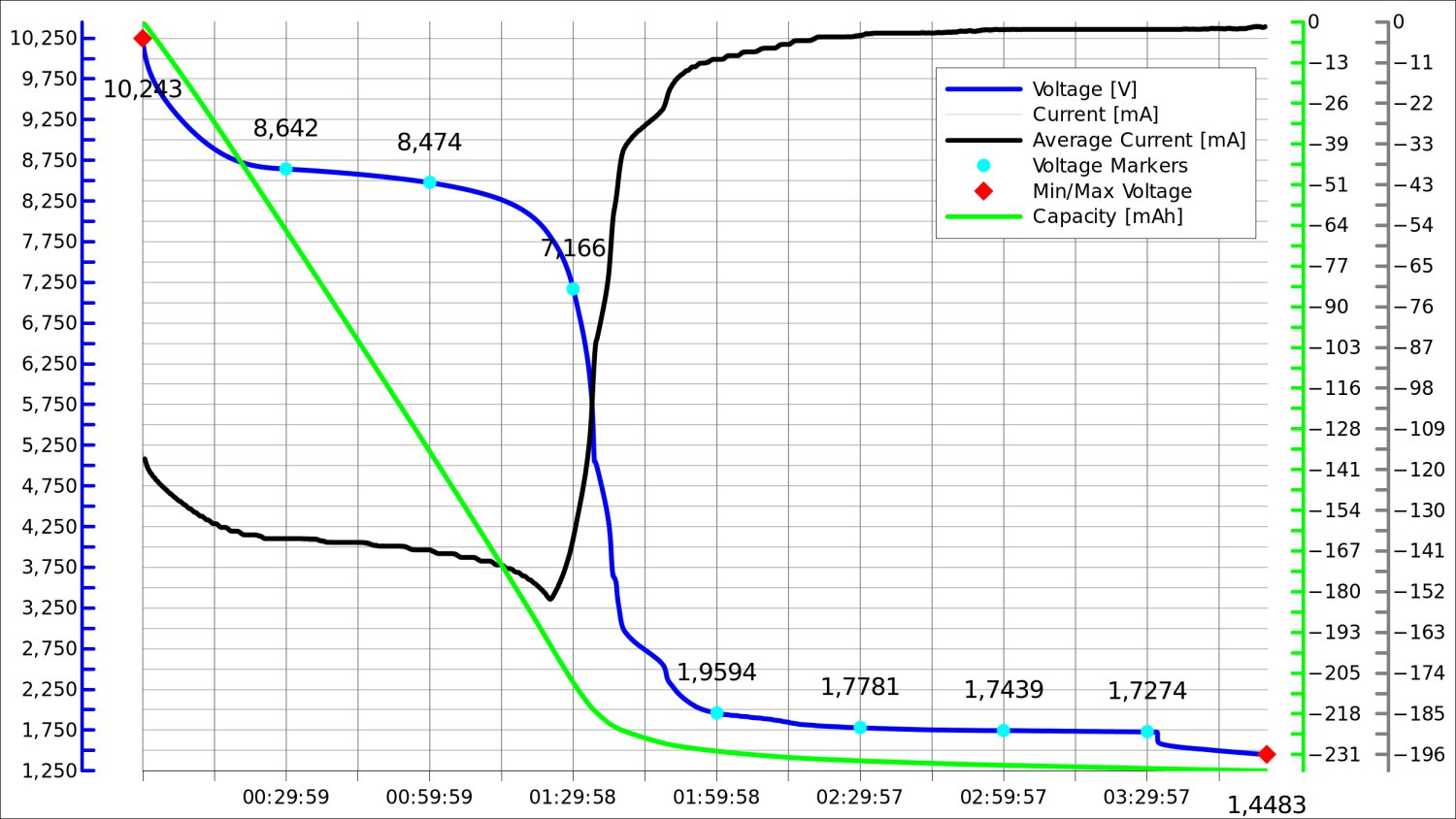
The 200 mAh battery lasted for about 1.5 hours of operation without access to electricity.
After this time, the battery is practically completely discharged - as seen in the graph, nearly 200 mAh was drawn from it during this time, which is the entire usable, declared capacity.
However, the device does not signal a low battery charge level in any way.
Additionally, the battery continues to discharge even when the device is no longer operating; after 4 hours, the voltage on the battery drops below 1.5V.
Not only was the battery previously heavily overcharged, but now left in the device, it can be very quickly permanently damaged - the minimum allowable voltage for this type of battery should not be lower than about 6-7V.
Summary.
The described device not only fails to handle the installed battery, but also poses a real threat to the user and the environment.
The attached basic instructions lack essential information about the parameters of the supported batteries.
There is no doubt that the device is not designed to handle the most popular Ni-MH 8.4V batteries. The adopted charging and discharging algorithm will also not be suitable for Ni-MH batteries with a voltage of 7.2V or 9.6V.
Due to the technical problems described above, the lack of markings, as well as formal deficiencies, raise doubts as to whether the device fulfills its primary role regarding the protection of property and health, being itself in the hands of an unaware user a potential bomb or a source of fire.
The problem is serious and is certainly not related to a single, random defect of the described detector specimen. The problem may concern a much larger number of devices; we confirmed the issues with battery handling on a completely different specimen (different brand) of the detector with an identical appearance.
Author: Michał Seredziński
Copying the content of the text or its parts without the consent of a representative of Baltrade sp. z o.o. is prohibited.