
- Tips
- technology
- Frequently Asked Questions
- Tests
- mAh capacity
- Rated Capacity
- comparison
- everActive
- Batteries vs rechargeable batteries
- Accumulated energy
- Durability of rechargeable batteries
- Efficiency of rechargeable batteries
- battery voltage
- LR03 AAA
- LR6 AA
- eneloop
- AG13 LR1154 LR44
- CR 2032
- Delta V
- Charge Cycles
- internal resistance
- charge level
- memory effect
- accredited test
- SR44 357
- Hearing Batteries 675
- SR626 377
- Watch Batteries
- Polarity
- Mah
- passivation
- LS 14250
- LS 14500
How to properly use nickel-metal hydride batteries?



We point out common simple mistakes that ultimately lead to faster wear of rechargeable batteries. Have you ever experienced that new, branded rechargeable batteries last much shorter than they should? Read our guide, and you may avoid later disappointment.
Table of Contents:
- Problem 1: Using rechargeable batteries immediately after removing them from the packaging
- Problem 2: Using the lowest charging currents
- Problem 3: Additional discharging of the battery in the charger before each subsequent charging
- Problem 4: Incorrect (too low) capacity measurements of a new battery. Measurement and interpretation of battery capacity in charging mode
- Problem 5: Problems with charging new batteries or those that have not been charged for a long time. Overcharging, overheating, undercharging of batteries
- Problem 6: Choosing the highest capacity batteries for all devices
- Problem 7: Using rechargeable batteries as direct replacements for disposable batteries in all devices
- Problem 8: The charger requires charging batteries in pairs
- Problem 9: Using different batteries in one device

Problem 1: Using rechargeable batteries immediately after removing them from the packaging
We definitely recommend charging Ni-MH batteries fully before first use.
Although most batteries are described as ready to use. We must be aware that no battery will be factory charged to 100%. The highest capacity batteries usually do not exceed 50% of factory charge, and even branded batteries with low capacity offer about 70-80% of initial charge.
Additionally, there are uneven sets and some cells may be factory charged to different degrees. If we use an uneven set in our device, we amplify the later negative consequences:
- the device operates much shorter,
- we risk too deep discharging the weakest cells from the set,
- the weakest of the batteries, although originally technically sound, may never achieve full nominal parameters again.
In the case of extremely low discharge of a completely new battery, we will have significant problems with its proper charging (how to deal with this is described in another article - link). Most advanced chargers may detect such a battery as faulty. Additionally, any too low discharge of the battery leads to partial, irreversible loss of performance, capacity, stability of such a cell.
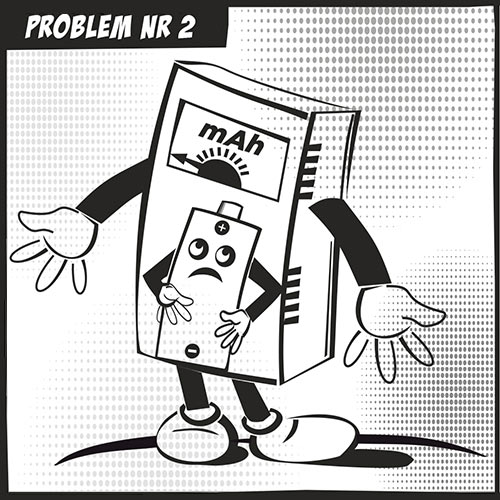
Problem 2: Using the lowest charging currents
If we have the option, avoid chargers with low charging current, where the result is charging times exceeding 5-6 hours.
Most users are still convinced that the lower the charging current, the better for the battery. This thesis is not completely wrong, but here the key role is played by the charger used. With a low current of 100-300 mA, we can almost safely charge all AA/AAA batteries, provided we also control the charging time and charge batteries that were previously completely discharged.
If we have an automatic charger, then the charging current cannot be too low - with a low charging current, due to the characteristic voltage curve of Ni-MH batteries, it is impossible to precisely determine the moment of full charging of the battery automatically. In such situations, even the best charger may have problems. With too low a current in an automatic charger (which will be a value of 200-300 mA for most currently produced batteries), there is regularly incomplete charging or significant overcharging of the batteries.
If we repeat this process regularly, unfortunately, the charged batteries may become very uneven, and as a result, the entire set may quickly degrade and wear out prematurely.
It can be simply assumed that the charger must have a charging current of at least 400-500 mA per cell for the proper automatic termination of charging for most Ni-MH batteries (regardless of their size). If the charger charges typical AA 2000 mAh batteries for longer than 5-6 hours, it probably does not meet this criterion and may cause problems, leading to faster wear of the batteries.
To better understand this problem, we recommend reading our other article - link.

Problem 3: Additional discharging of the battery in the charger before each subsequent charging
This is absolutely a bad habit that we should avoid in the case of Ni-MH batteries.
We have described this issue quite extensively before - link. The most important argument should be the fact (confirmed based on official tests of Eneloop batteries) that a battery that is completely discharged each time shows about 4 times lower lifespan than a battery discharged to about 50%. This means that a battery that is not completely discharged each time can deliver even 100% more energy during its lifetime. The lifespan of batteries drops by another 50% if we regularly allow them to discharge below the safe voltage of 1.0V.
In the case of Ni-MH batteries, it is not worth being afraid of the memory effect or lazy battery effect. Even if such an effect occurs, it will be less problematic than the consequences of synthetic, excessive wear of batteries due to their additional discharging in the charger.

Problem 4: Incorrect (too low) capacity measurements of a new battery. Measurement and interpretation of battery capacity in charging mode
A too low result returned by the charger does not always indicate a defect in the battery.
Ni-MH batteries require at least a few charging cycles to properly form. Do not expect full performance from the battery after just 1-3 charges. The capacity during the first several charging cycles on a good quality cell gradually increases. Additionally, such a battery shapes its target voltage characteristic with each subsequent charging cycle. For example, it is typical to achieve a lower maximum voltage (even by 0.05V) for completely new, unformed batteries.
Another mistake is estimating the capacity of a new cell based on the mAh value used to charge such a battery. A Ni-MH battery can take from about 100 mAh to even multiples of its nominal capacity during charging attempts, depending on the situation - this does not have to correlate with its actual capacity.
Here is an important note about trying to form batteries directly in chargers.
We previously wrote that new batteries should first be fully charged and then, as much as possible, avoid deep discharging. Many chargers have refresh modes that automatically cycle batteries through multiple discharges and charges. This seemingly convenient and relatively quick process seems ideal for forming new batteries - however, it often does not lead to achieving maximum nominal capacities for batteries and may not translate into optimal lifespan during future use. New batteries do not like discharging below 1.0V, and at the same time, chargers often have problems fully charging them during the first charging cycles.
New batteries are best given some time to properly form - I do not recommend doing this synthetically through multiple charging and discharging directly in the charger.
The Refresh mode works best on old cells, of uncertain condition, or those that may have been affected by the lazy battery effect.

Problem 5: Problems with charging new batteries or those that have not been charged for a long time. Overcharging, overheating, undercharging of batteries
In the case of the first charging cycles, some batteries require special attention.
New batteries, like those that have not been placed in the charger for a long time, can be unpredictable during the first charging attempts.
Even if we choose the charging current appropriately, it happens that either the charger turns off charging prematurely or leads to overcharging/significant heating of such batteries. In the case of completely new batteries, we should try to supervise the charging process - controlling its time and the temperature of the cells. If the batteries become very warm (where it is difficult to keep a finger on the cell), we should stop the charging process.
This phenomenon results from a certain anomaly - some batteries will not show a significant increase in voltage in the final phase of charging. Such batteries begin to heat up at about 0.03-0.05V below their typical voltage level. Voltage stabilization occurs at a relatively low level without a noticeable, expected drop, being the main determinant of full charging of the battery. In such a situation, even despite the increase in temperature on the cell, the battery is usually not properly charged to full, and any charger may have significant problems with properly completing the charging process.
In the case of functional batteries, the problem usually disappears with subsequent charging cycles.
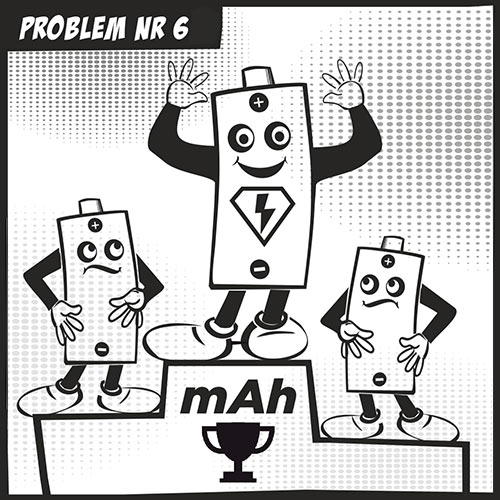
Problem 6: Choosing the highest capacity batteries for all devices
A battery with the highest capacity will not always be suitable for our application.
The capacity value expressed in mAh is often the main criterion for choosing power for our devices. A higher mAh capacity means a longer operating time - but is that really the case?
Batteries with the highest capacities like 2500 mAh for AA or 1000 mAh for AAA are heavily stressed constructions and at the same time very technologically advanced. They have a high capacity that is very close to the maximum technological limit for Ni-MH technology. Usually, such batteries also have low resistance and high current efficiency.
Unfortunately, typical AA 2450 mAh batteries usually age 3-5 times faster compared to batteries with capacities of 1900 mAh. Such highest capacity batteries often behave very unpredictably after 2-3 years of use - even if they were rarely (or not at all) used. Additionally, they handle deep discharges worse. The capacity and resistance parameters of the highest capacity batteries degrade and worsen much faster than those of more common batteries with lower nominal capacities. Additionally, the self-discharge voltage drop is much more noticeable on the highest capacity batteries - and consequently, the self-discharge effect is also more perceptible to the user.
The highest capacity batteries are primarily dedicated to demanding devices, where the intervals between subsequent charges are predictable and do not exceed a few weeks. They perform best in professional applications where momentary efficiency is of utmost importance.
If you want to use batteries in devices that operate on such power for long weeks or months or are used occasionally, models with moderate capacities, not exceeding 800 mAh for AAA R03 or 2100 mAh for AA R6, will be a better choice.
Similarly, when our batteries are charged very regularly - e.g., daily in a cordless phone or solar lamp, we should choose batteries with possibly low capacities (and at the same time much higher lifespans).
If our devices operate for many months or years on typical disposable batteries, using rechargeable batteries may be completely unjustified.

Problem 7: Using rechargeable batteries as direct replacements for disposable batteries in all devices
In many devices, using rechargeable batteries does not bring any benefits, either economic or ecological.
Proponents of using rechargeable batteries instead of disposable batteries often cite longer operating time of rechargeable batteries and ecological reasons as the main argument. However, both arguments do not always have confirmation in practice. Rechargeable batteries do not always operate optimally and longer in a given device. The carbon footprint of producing Ni-MH batteries is several times higher than that of a typical alkaline battery. It is completely pointless to install batteries (especially the highest capacity ones) in devices that do not require battery replacement for a year or longer.
After 2-3 years of use (regardless of its nature), almost all the highest capacity Ni-MH batteries turn out to be very unreliable and unpredictable.
If we absolutely want to install rechargeable batteries in virtually all devices, then in the case of devices where we very rarely replace batteries, they should be batteries with much lower capacities - e.g., 500 mAh for AAA R03 or 1000 mAh for AA R6.
The only argument that actually speaks for rechargeable batteries is their almost total resistance to leaking. Ni-MH batteries, due to their construction, very rarely leak spontaneously during their entire use, unless provoked "from the outside" (e.g., through short-circuiting, mechanical damage, extreme temperatures, excessive overcharging, or too deep discharging, which may be accompanied by destructive cell depolarization).

Problem 8: The charger requires charging batteries in pairs
This is a strong simplification and in my opinion a design flaw of some chargers - if we still use such a charger, we should consider replacing it with one that has an appropriately high charging current and independent charging channels.
There are still models of chargers on the market that require installing batteries in pairs. Such chargers should be avoided, as we usually do not have equal batteries, with exactly the same level of charge/discharge, and installing an uneven pair in such a charger will always result in suboptimal charging. In the long run, this will mean a significant reduction in the lifespan of our cells.
Additionally, such chargers often have very low charging currents, making it even more difficult to assess their full charging (according to point 2).
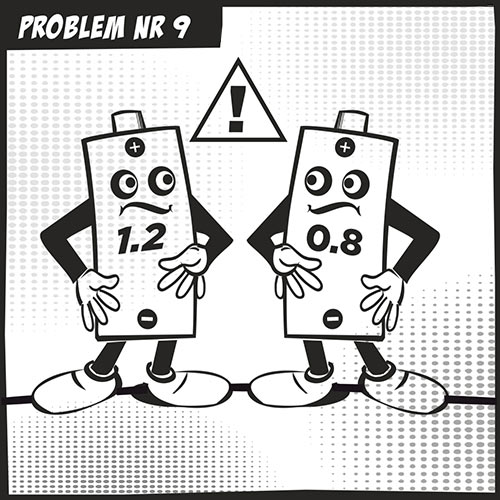
Problem 9: Using different batteries in one device
Avoid this if we care about the lifespan of the batteries.
Installing different batteries or uneven ones with different levels of charge in a set usually results in too deep discharging of the weakest cell and significantly shortened operating time of the entire device. As a result, this extremely discharged battery will be unnecessarily and permanently damaged in such situations - as we described in point 1.
Author: Michał Serediński
Copying the content of the article or its parts without the consent of a representative of Baltrade sp. z o.o. is prohibited.
Recommended batteries in the store hurt.com.pl:
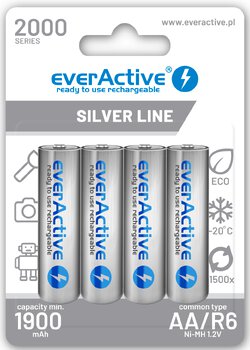
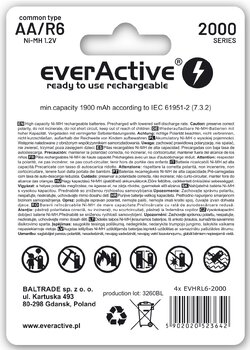
4 x AA / R6 everActive Ni-MH 2000 mAh rechargeable batteries ready to use "Silver line"
- excellent batteries at a low price
- 4pcs - factory consumer packaging - blister
- tested performance - real capacity
- pre-charged batteries, next generation made with Ready To Use technology
- highest quality of batteries confirmed by numerous tests
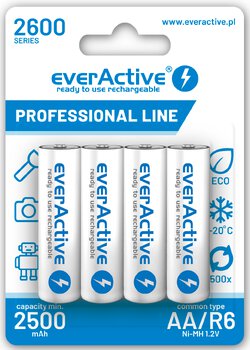
4 x AA / R6 everActive Ni-MH 2600 mAh rechargeable batteries ready to use "Professional line"
- excellent batteries at a low price
- 4pcs. - factory consumer packaging - blister
- tested performance - real capacity
- pre-charged batteries, next generation made with Ready To Use technology
- highest quality of batteries confirmed by numerous tests
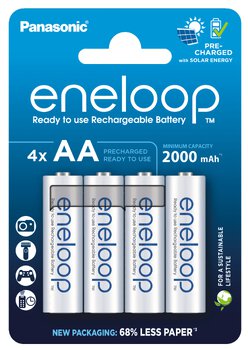
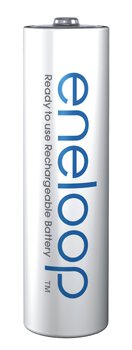
4 x AA / R6 Panasonic Eneloop Ni-MH 2000mAh BK-3MCDE/4BE (blister)
- higher capacity min. 2000 mAh
- up to 2100 charging cycles
- retains 70% energy after 10 years from charging!
- operates in low temperatures down to -20°C!
- charged in the production process with solar energy
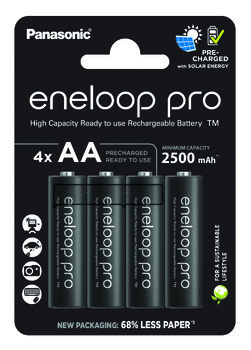
4 x R6 / AA Panasonic Eneloop PRO NEW Ni-MH 2500mAh BK-3HCDE/4BE (blister)
- highest capacity among new generation rechargeable batteries 2500 mAh
- retains 85% of energy after 12 months from charging!
- operates in low temperatures down to -20°C!
- charged during production with solar energy