
- Tips
- technology
- Frequently Asked Questions
- Tests
- mAh capacity
- Rated Capacity
- comparison
- everActive
- Batteries vs rechargeable batteries
- Accumulated energy
- Durability of rechargeable batteries
- Efficiency of rechargeable batteries
- battery voltage
- LR03 AAA
- LR6 AA
- eneloop
- AG13 LR1154 LR44
- CR 2032
- Delta V
- Charge Cycles
- internal resistance
- charge level
- memory effect
- accredited test
- SR44 357
- Hearing Batteries 675
- SR626 377
- Watch Batteries
- Polarity
- Mah
- passivation
- LS 14250
- LS 14500
How does a battery work?
2019-06-19
20


24
7
Looking at the battery, we can see that it has two terminals - one positive, marked with "+", and the other negative - marked with "-". In the case of typical cylindrical batteries, such as R6/AA or R14/C (used, for example, to power flashlights or toys), the terminals are the ends of the battery. In car batteries, the terminals are heavy lead clamps.
Electrons gather at the negative terminal of the battery. If we connect the negative terminal to the positive one with a wire, the electrons will move as quickly as possible from the negative terminal to the positive one - the battery will drain very quickly (additionally, we discourage such experiments due to the associated dangers - never short-circuit a battery like this "for a moment"!). Under normal conditions, we connect some load to the battery with a wire - a light bulb, a small motor, or an electronic circuit, such as a radio.
Inside the battery, a reaction occurs that generates free electrons. The speed at which electrons are released as a result of this reaction (internal resistance - resistance - of the battery) obviously limits the number of electrons that can flow between the terminals. Electrons must flow from the battery through the wire and load, from the negative to the positive terminal, for a chemical reaction to occur that will release even more of them. For this reason, we can leave an unused battery on the shelf for example for a year, after which we can continue to use it without any problems - as long as electrons do not flow from the negative to the positive terminal, the chemical reaction does not occur. The moment the terminals are connected - the reaction begins.
Chemical Reactions in Batteries
One of the simplest batteries is the zinc-carbon battery. By looking at the reactions occurring inside it, we can more easily understand the general principle of operation of all batteries. Imagine that we have a jar of sulfuric acid (H2SO4). If we place a zinc rod in it, the corrosive acid will immediately start to dissolve it. We will see hydrogen bubbles forming on the surface of the zinc, and both the rod and the acid will begin to heat up.Here’s what happens:
- the acid molecules break down into three ions: two H+ ions and one SO4-- ion
- the zinc atoms on the surface of the rod lose two electrons (2e-) and become Zn++ ions
- Zn++ ions combine with SO4-- ions to form ZnSO4, which dissolves in the acid
- electrons from the zinc atoms combine with H+ ions to form H2 molecules (gaseous hydrogen)
- electrons will start to move along the wire and combine with hydrogen on the carbon rod, from which hydrogen bubbles will also start to be released
- the heat release will significantly decrease; using the electricity flowing through the wire, we could for example power a light bulb - and measure the resulting voltage and current flowing through the wire - part of the thermal energy has been converted into the movement of electrons.
Batteries that we know operate on the same principle. They differ in the types of metals and electrolytes used, but they all work thanks to the same phenomenon - electrons flowing from one terminal to another. Depending on the components used, the characteristic voltage of such a battery also changes. Let's trace this with the example of a typical lead-acid car battery:
- the battery contains one plate made of lead and another made of lead dioxide, both immersed in an electrolyte of highly concentrated sulfuric acid
- lead combines with SO4 to form PbSO4 and one free electron
- lead dioxide, hydrogen ions and SO4 ions, along with electrons from the lead plate, form PbSO4 and water on the lead dioxide plate over time, both plates are covered with PbSO4, and the water mixes with the acid; the characteristic voltage is about 2V - thus, connecting 6 cells in series gives us a battery of cells with a voltage of 12V
- zinc-carbon batteries - so popular that they are sometimes called "regular"; these are the most commonly used batteries, in sizes such as R6/AA, R14/C, R20/D; the electrodes are made of zinc and
- carbon, with an acid paste placed between them, serving as the electrolyte
- alkaline batteries - their electrodes are made of zinc and manganese oxide, with an alkaline electrolyte
- lithium batteries - use lithium, lithium iodide, or lead iodide; they are most often used in cameras, as they can deliver energy in short, large bursts (required for powering flash lamps)
- zinc-air batteries - used to power hearing aids.
- lead-acid batteries - used in cars; the electrodes are made of lead and lead oxide, with highly concentrated acid as the electrolyte
- nickel-cadmium (Ni-Cd) batteries - the electrodes are made of nickel hydroxide and cadmium, with potassium hydroxide as the electrolyte
- nickel-metal hydride (Ni-MH) batteries - quickly replaced nickel-cadmium batteries in most applications due to the lack of "memory effect" attributed to Ni-Cd batteries
- lithium-ion batteries - with an excellent capacity-to-weight ratio, most commonly used in laptops and mobile phones.
Connecting Cells / Batteries
In previous discussions, we used the words "battery" and "cell" interchangeably. This is in line with the tendency in colloquial language. However, from a technical point of view, the words "battery" and "cell" have quite different meanings. Thus, "cell" refers to a single power source, such as the jar of acid and two rods connected by a wire described at the beginning (or for example, an "AA" R6 cell). "Battery," on the other hand, is a set of connected cells (such as a 3R12 battery, consisting of three cells in one casing, connected in series). In this sense, we will use these two terms in the rest of this text.In most devices, we do not usually use a single cell. Instead, we connect several of them - either in series, to achieve a higher voltage, or in parallel - to achieve higher currents. In a series connection, we obtain the sum of the voltages of the connected cells; in a parallel connection - the sum of the currents obtained from the component cells.
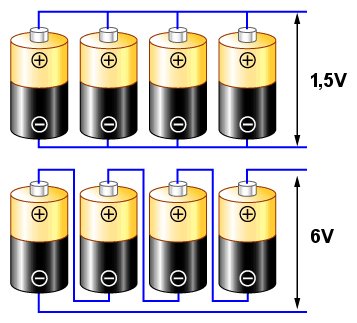
The connection shown in the upper diagram is called parallel. If we assume that each of the cells has a characteristic voltage of 1.5V (like a typical single zinc-carbon or alkaline cell), then the voltage obtained at the terminals (indicated by arrows) will still be 1.5V, but the current obtained will have four times the intensity of that which we would obtain from a single cell.
The connection shown in the lower diagram is called series. In this case, the voltages from the individual cells add up, giving a voltage of 6V between the terminals.
When buying a battery or cell, you can usually read its voltage on the packaging - sometimes also the capacity. For example, typical rechargeable batteries used in digital cameras have a voltage of 1.2V and a capacity of 2000mAh. A capacity of 2000mAh (mAh is short for milliampere-hour) means that, theoretically, such a battery can deliver a current of 2000mA (2000 milliamperes, or 2 amperes) for one hour, a current of 1A for two hours, a current of 100mA for 20 hours, etc. However, cells usually do not behave linearly at all. First, every battery has a specific maximum current intensity that it is capable of delivering. Thus, a 500mAh battery will not be able to deliver a current of 30A for a second, because there is no way for the chemical reactions occurring inside the battery to deliver that many electrons in such a short time. Second, at high currents, cells usually heat up significantly, wasting a lot of their energy. Third - many chemical systems used in batteries operate shorter (or longer!) at very low current draws. Nevertheless, the capacity measured in ampere-hours gives a fairly good idea of how long a given cell will last at a specific current draw, under typical operating conditions.
Copyright © Baltrade
20
24
7
Add a comment