
- Tips
- technology
- Frequently Asked Questions
- Tests
- mAh capacity
- Rated Capacity
- comparison
- everActive
- Batteries vs rechargeable batteries
- Accumulated energy
- Durability of rechargeable batteries
- Efficiency of rechargeable batteries
- battery voltage
- LR03 AAA
- LR6 AA
- eneloop
- AG13 LR1154 LR44
- CR 2032
- Delta V
- Charge Cycles
- internal resistance
- charge level
- memory effect
- accredited test
- SR44 357
- Hearing Batteries 675
- SR626 377
- Watch Batteries
- Polarity
- Mah
- passivation
- LS 14250
- LS 14500
What factors affect the operating time of zinc-air hearing aid batteries?
2019-04-26
6


22
2
The battery life primarily depends on the power consumption of the hearing aid itself and the set amplification level.
The level of external noise is also significant.
The battery life will definitely be longer if the user remembers to turn off the device when it is not in use (e.g., during sleep).
It should also be noted that unfavorable environmental conditions such as too high or too low temperatures, high humidity, or air pollution – can negatively affect the performance of any zinc-air battery in the hearing aid.
Return to: List of articles on hearing aid batteries

Users of hearing aid and implant batteries often notice a change in battery life. The duration of battery life primarily depends on the power consumption of the device. It can vary in situations:
- With increased sound amplification, e.g., in situations where we often stay in a noisier environment. Batteries will therefore be consumed faster when we are in a restaurant or at concerts. Also, setting the device volume to higher levels will lead to quicker battery depletion.
- Zinc-air batteries are sensitive to environmental conditions. A drop in ambient temperature will shorten battery life. This should be remembered by people, e.g., working outside in winter.
- Increased altitude also means a decrease in oxygen content in the air. Therefore, if you are in the mountains, your battery may operate for a shorter time.
- Another aspect may be the fact of the user's hearing impairment deepening, resulting in the need for sound amplification in the device.
- Even air pollution can affect the operation time of the hearing aid battery.
Copyright © Baltrade
Watch also the video discussing the rules for using hearing aid batteries
Popular hearing aid batteries at hurt.com.pl
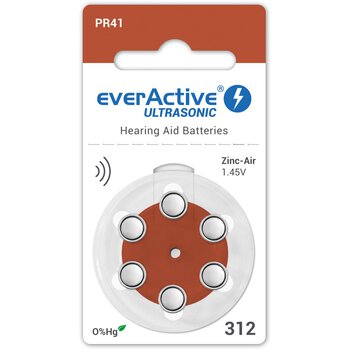
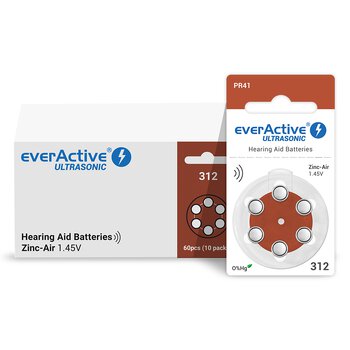
30 x everActive ULTRASONIC 312 hearing aid batteries
Batteries 312 / PR41
- reliable zinc-air batteries for hearing aids
- voltage: 1.45V
- environmentally friendly batteries - mercury-free (0% Hg)
- expiration date: min. 2029
4,25 € gross
4,25 € net
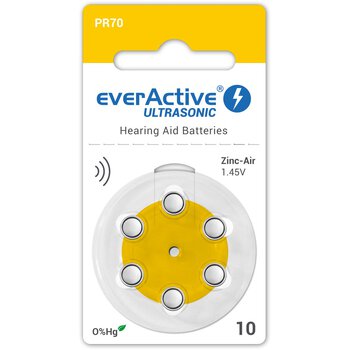
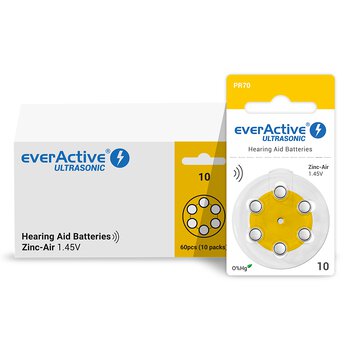
30 x everActive ULTRASONIC 10 hearing aid batteries
- reliable zinc-air batteries for hearing aids
- voltage: 1.45V
- environmentally friendly batteries - mercury-free (0% Hg)
- expiration date: min. 2029
4,25 € gross
4,25 € net


30 x everActive ULTRASONIC 13 hearing aid batteries
- reliable zinc-air batteries for hearing aids
- voltage: 1.45V
- environmentally friendly batteries - mercury-free (0% Hg)
- expiration date: min. 2029
4,25 € gross
4,25 € net
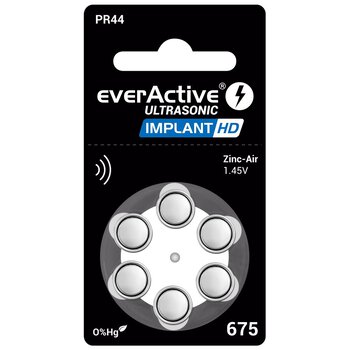
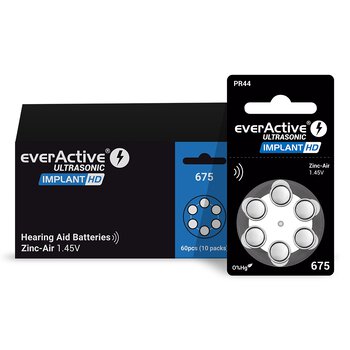
30 x everActive ULTRASONIC IMPLANT HD 675 hearing aid batteries
- reinforced, high-current version of battery 675 with increased performance
- dedicated to cochlear implants and speech processors
- voltage: 1.45V
- environmentally friendly batteries - mercury-free (0% Hg)
- expiration date: min. 2029
7,35 € gross
7,35 € net
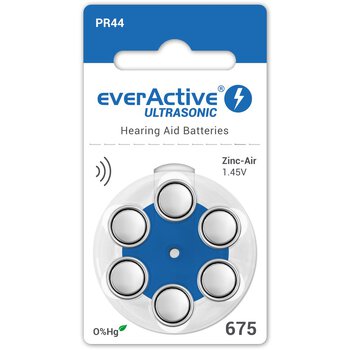
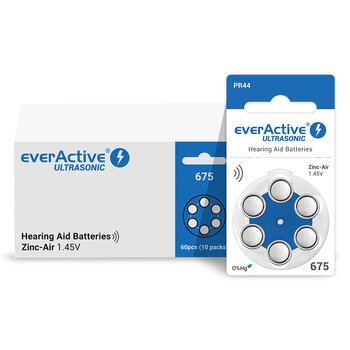
30 x everActive ULTRASONIC 675 hearing aid batteries
- reliable zinc-air batteries for hearing aids
- voltage: 1.45V
- environmentally friendly batteries - mercury-free (0% Hg)
- expiration date: min. 2029
4,25 € gross
4,25 € net
6
22
2
Add a comment