
- Tips
- technology
- Frequently Asked Questions
- Tests
- mAh capacity
- Rated Capacity
- comparison
- everActive
- Batteries vs rechargeable batteries
- Accumulated energy
- Durability of rechargeable batteries
- Efficiency of rechargeable batteries
- battery voltage
- LR03 AAA
- LR6 AA
- eneloop
- AG13 LR1154 LR44
- CR 2032
- Delta V
- Charge Cycles
- internal resistance
- charge level
- memory effect
- accredited test
- SR44 357
- Hearing Batteries 675
- SR626 377
- Watch Batteries
- Polarity
- Mah
- passivation
- LS 14250
- LS 14500
Slow or fast charging of a phone or smartwatch? What impact do we have on the charging speed (and lifespan?) of Li-ion batteries in smartphones, etc.?


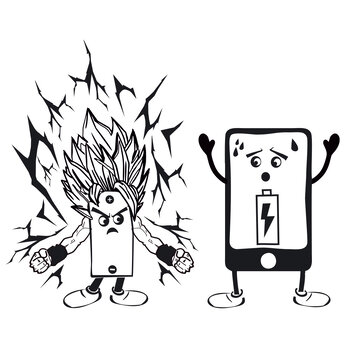
A large number of charging standards, standard chargers, slow, fast, Quick Charge, Power Delivery, PPS… It is easy to get lost in the current technologies for charging mobile devices, but it is worth knowing the basic principles of operation as well as the impact of the charger used on the performance of our equipment. We will divide the discussed topic into several scenarios along with typical questions and doubts from our customers. The article concerns the typical charging technique using a cable with a USB-A connector – the topic of wireless, inductive charging is governed by additional rules and limitations, which may be the subject of another, future post on our blog.
1. My smartwatch requires a 5V 1A charger, while there are popular models on the market with higher power and current efficiency. I'm afraid that I will burn my device with a 5V 3.4A charger.
Typical 5V USB chargers are nothing more than power supplies, serving as a power source for the connected device. The most important aspect we should remember is that the connected device imposes its conditions on such a charger – in other words, it will want to draw a specific, predetermined amount of energy from the charger. A device designed for a 5V 500 mA charger will charge in exactly the same way and at the same speed even if we connect it to a charger that is several times faster and more powerful. Also, from a user perspective, there is nothing to prevent such a low-power device from being connected to a more powerful charger – but only under one condition – only if the output voltage of both chargers is identical – in the case of typical chargers with a basic USB output, the typical voltage is 5V DC.
2. So a new, universal 5V/5A charger will safely and optimally charge any less demanding device - even one that requires a maximum of 5V/0.5A?
A good quality, theoretically much more powerful USB charger will charge such devices in exactly the same way and at the same speed, as long as its output voltage (5V) is the same as that of the original charger.
There may be a few exceptions to this rule, but they will only concern unapproved and potentially dangerous devices, where the manufacturer did not ensure proper control of the charging process.
Using a weaker charger has only one potential advantage. A strong charger operating under very low load conditions – around 5% or 10% of its maximum efficiency – will operate with relatively low efficiency – meaning that slightly more energy drawn from the electrical grid will be wasted in the circuits of such a charger.
3. My phone has super-fast charging of 80W - it charges the battery in less than half an hour. I'm worried about the battery's lifespan, especially since it's not easy to replace.
Indeed, almost all currently available smartphones are equipped with solutions that accelerate the charging of the built-in battery. Despite manufacturers' assurances that this does not affect battery lifespan, there are justified concerns that such treatment of the battery will negatively impact its durability. I will cite here the basic arguments supporting the above thesis. Higher charging currents lead to higher temperatures of the components and the battery itself. As is commonly known, elevated temperature is one of the main criteria that have a direct impact on faster battery, accumulator, and overall electronic wear. Additionally, we must be aware that the ability to quickly accept and release energy is only present in a quality cell with low internal resistance. An increase in battery resistance associated with its natural wear will cause an even greater increase in temperature during charging, which in turn will lead to even faster further wear. The charging power of such a battery will at some point be significantly limited (safety mechanisms will activate) and despite similar charging times, the battery will already have a significantly reduced usable capacity – there is no turning back from this, and such a cell will only be suitable for replacement.
The most typical mechanism for accelerating charging involves using a higher voltage than 5V – e.g., 9V or 12V – to achieve such charging conditions, we need to have a suitable, compatible charger that negotiates the charging conditions with our phone and establishes the optimal (usually as fast as possible) charging rate. In a typical situation, we do not have much influence on the charging rate – wanting to “slow down” such a fast charger, a universal solution is to use a simpler, lower quality cable that has only charging functions – without data exchange – however, in the era of devices powered by USB Type C, such cables are rare.
In such a situation, it remains to use another standard charger that has a limited output voltage to standard 5V DC – e.g., models everActive SC-100, SC-200, SC-300, SC-400. After connecting such a standard charger, the connected device should not negotiate a higher charging power than 10-12W, which is already a relatively low value for the current batteries used in smartphones.
4. I purchased a standard, but very powerful USB charger everActive SC-400 5V 5A, after all, this is still a high current and up to 25W of power – is that still not too much for my devices?
As we wrote in point 1, it is not the charger, but the device that decides how much current it will draw from the charger. No popular smartphone will draw more than 2-2.4A from the standard 5V output of such a charger, even if the charger has greater capabilities. Additionally, using a longer cable or one with poorer electrical parameters will further slow down the charging process.
5. I want to maximize the lifespan of the battery in my phone, so I plan to buy a slow USB charger with a power of 5W 5V/1A.
On the surface, this seems like a good idea – such a charger will not be able to deliver significantly higher current, even if the device tries to force it, so we will actually limit the charging rate of the connected phone in this way.
However, this brings other possible consequences – a 5V/1A charger will operate at a continuous overload limit when powering a device that tries to draw 2A of current from it. The result will be an increased operating temperature of such a charger, and in extreme cases, its faster wear or even damage.
If the current efficiency of the used charger is lower than the actual requirements of our device, it may also cause other anomalies – including incorrect operation or disconnection of the connected device.
6. My smartwatch comes with a 5V/1A charger, in my opinion, that is too much for such a small battery – is it worth looking for a 5V/0.5A charger?
As we described in point 1, such a smartwatch is designed for a specific charging rate and regardless of which charger we connect, the charging power will not be higher than that which was designed by the manufacturer. Will it be lower – not necessarily – a typical smartwatch or smartband usually does not draw more than 0.2-0.5A from a typical charger, regardless of whether it is a 0.5A, 1A, or 3A charger.
Summary
If we really have concerns about the too fast charging rate of our phone, a reasonable solution is to purchase a standard USB charger with a limited output voltage of 5V – such models include everActive SC-100, SC-200, SC-300, SC-400. A phone powered by such a standard charger will not charge with a power higher than 5-12W, regardless of the fast charging technology implemented by the manufacturer of our smartphone.
In the case of smartwatches or smartbands, the situation is even simpler, as these devices have a predetermined charging rate and do not support sophisticated fast charging technologies – here we can use practically any USB charger, and the effect will be similar.
However, let us remember that the charger should not be weaker than the minimum requirements of our device – as we described in point 4 – using a charger with lower current efficiency may lead to significant overheating and operation in non-optimal conditions for both the charger and the connected device. In the case of devices powered from a 5V USB port, however, there is nothing to prevent the use of a charger with higher current efficiency – the only negative consequence may be slightly lower efficiency of the charger's operation – as per point 2.
Copying the content of the article or its parts without the consent of a representative of Baltrade sp. z o.o. is prohibited.
Recommended standard USB 5V DC chargers available in our warehouse:
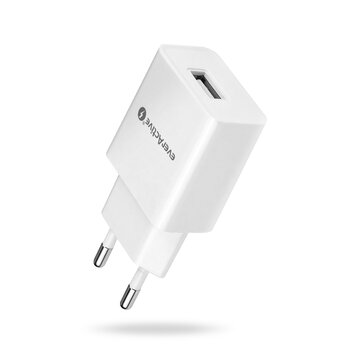
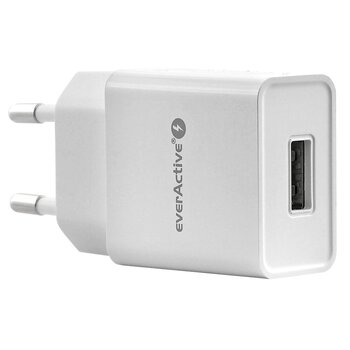
everActive SC-100 1xUSB 1A wall charger for phone/smartphone
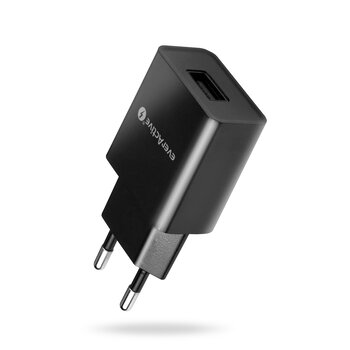
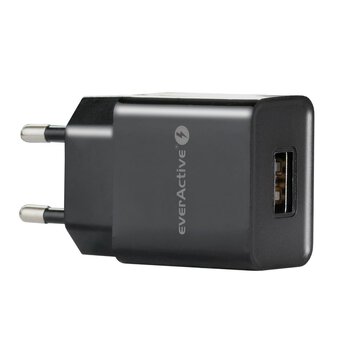
everActive SC-100B 1xUSB 1A wall charger for phone/smartphone
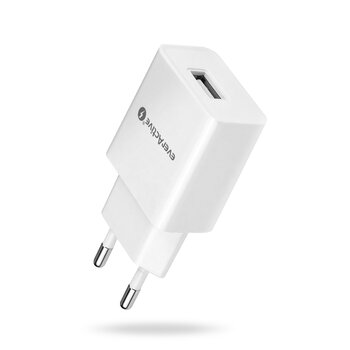
everActive SC-200 1xUSB 2.4A wall charger for phone/smartphone
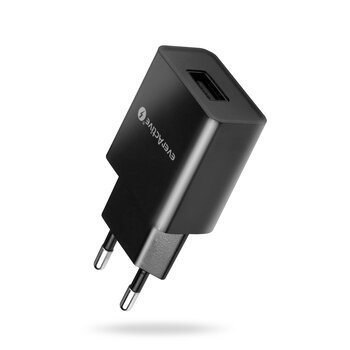
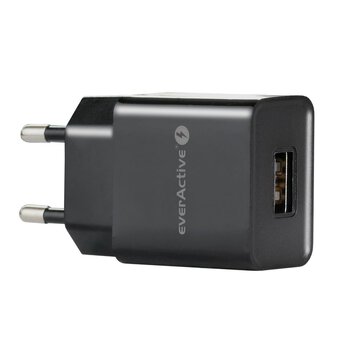
everActive SC-200B 1xUSB 2.4A wall charger for phone / smartphone
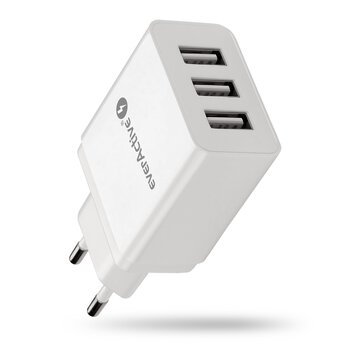
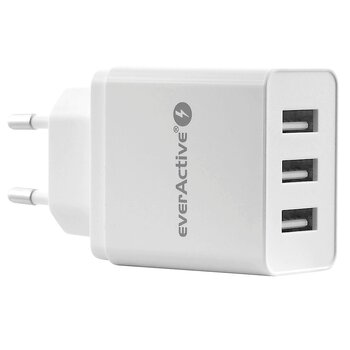
everActive SC-300 3xUSB 3.4A wall charger for phone / smartphone
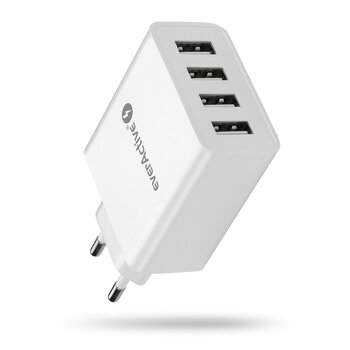
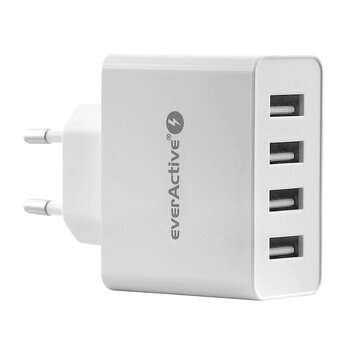
everActive SC-400 4xUSB 5A wall charger for phone/smartphone
-
OK, to dlaczego w instrukcji producent zastrzega - "ładowarkę do 2 A4604
3
0
-
To pytanie do producenta urządzenia. Od strony technicznej zdanie w takiej formie nie ma uzasadnienia.
Wartość 2A to już dość wysokie natężenie bliskie maksymalnemu (2.4A) dopuszczalnemu z typowego, pojedynczego wyjścia USB 5V. Także trochę niezrozumiały jest taki zapis - takie ograniczenie jest w zasadzie nieskuteczne - praktycznie nie wyklucza zastosowania żadnej ładowarki.
Przy mniejszych wartościach - np. zapisie w instrukcji wartości 0,5A, czy 1,0A można się zastanawiać, co producent miał na myśli - albo dba o wysoką efektywności procesu ładowania - o tym wspominamy w artykule, albo boi się, że jeżeli w trakcie ładowania zawiedzie układ ładowania w jego urządzeniu to takie podłączone źródło zasilania zostanie zwarte - wówczas prąd zwarciowy 2,4A dla elektroniki jest na pewno bardziej destrukcyjny niż 1A - jednak to już wtórne następstwa już po wystąpieniu awarii w podłączonym urządzeniu. Subiektywnie takie zapisy oceniam jako dodatkowe zabezpieczenie producenta urządzenia, które może przy okazji świadczyć o wątpliwej jakości układu ładowania w samym urządzeniu.4613
3
0
-