
- Tips
- technology
- Frequently Asked Questions
- Tests
- mAh capacity
- Rated Capacity
- comparison
- everActive
- Batteries vs rechargeable batteries
- Accumulated energy
- Durability of rechargeable batteries
- Efficiency of rechargeable batteries
- battery voltage
- LR03 AAA
- LR6 AA
- eneloop
- AG13 LR1154 LR44
- CR 2032
- Delta V
- Charge Cycles
- internal resistance
- charge level
- memory effect
- accredited test
- SR44 357
- Hearing Batteries 675
- SR626 377
- Watch Batteries
- Polarity
- Mah
- passivation
- LS 14250
- LS 14500
What batteries for smoke and carbon monoxide detectors? 9V, AA, alkaline or lithium?


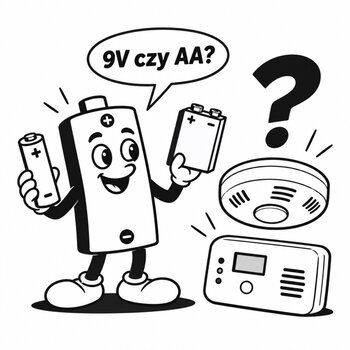
Smoke and carbon monoxide detectors, commonly referred to as carbon monoxide, are becoming increasingly common fixtures in homes, apartments, hotels, and commercial properties. However, purchasing a detector is not everything. If the device is powered by replaceable batteries, selecting the appropriate power source and its regular monitoring is equally important.
In many sensors, we will encounter the well-known rectangular 9V battery (such as alkaline batteries 6LR61), while others use popular batteries AA (LR6) or AAA (LR03). Increasingly, devices with a non-replaceable lithium battery, designed to last several or even dozens of years, are also available.
So can you just buy any 9V battery for a sensor powered by a 9V battery? Is a lithium battery always better than an alkaline one? Or maybe it's worth using a rechargeable battery?
Unfortunately, the answer is not always obvious. We explain.
What type of battery should be used for a smoke or carbon monoxide detector?
The simplest and at the same time most important answer is:
you should use exactly the type of battery that was specified by the manufacturer of the specific sensor.
It is not enough that the battery physically fits the device and has the correct voltage.
Individual sensors may be adapted to work with different battery technologies, and their voltage control circuit may be calibrated for a specific discharge method of the cell. Therefore, it is worth checking the user manual or the markings inside the battery compartment before purchasing.
Most often, we can encounter the following solutions:
| Power Type | Typical Marking | Most Common Solution |
|---|---|---|
| 9V rectangular battery | 6LR61, 6F22 | alkaline, sometimes zinc-carbon or lithium |
| AA 1.5V battery | LR6 / AA | most often alkaline |
| AAA 1.5V battery | LR03 / AAA | most often alkaline |
| several AA/AAA batteries | e.g. 2 × AA | set of identical batteries |
| built-in battery | most often lithium | non-replaceable by the user |
The above table is for reference only. The decisive factor is always the instruction of the specific sensor.
The manufacturer may allow several types of batteries or, conversely, specify a very specific technology, or even specific cell models.
9V battery for the sensor – 6LR61, 6F22 or “R9”?
The characteristic rectangular 9V battery is one of the most commonly associated power sources for smoke detectors.
In stores, you can find several markings for batteries of this shape:
- 6LR61 – 9V alkaline battery,
- 6F22 – 9V zinc-carbon battery,
- 9V / R9 – terms often used colloquially or sometimes commercially,
- and in the case of lithium batteries, also manufacturer markings such as L522, LA522 or CR-V9.
Although all these batteries may have very similar dimensions and the same nominal voltage of 9V, this does not automatically mean that each of them can be used in every sensor.
On the offer of hurt.com.pl, both alkaline 9V batteries / 6LR61 and lithium 9V batteries.
Alkaline or lithium battery – which one will be better?
Intuitively, one might assume that since the lithium battery is more expensive, has a long shelf life, and usually very good discharge characteristics, it will also be the best choice for the sensor.
Not necessarily. It all depends on the design of the device.
A good example is the Brennenstuhl RM C 9010 smoke detector, for which the manufacturer allows 9V zinc-carbon, alkaline, and lithium batteries. However, there are also sensors from other manufacturers where the instructions explicitly state that lithium batteries should not be used. For example, the instructions for one of the Kidde models with a replaceable 9V battery specify certain alkaline batteries and explicitly prohibit the use of lithium batteries.
Therefore, one cannot assume the rule: “lithium is better, so we always replace it with alkaline.”
If the manufacturer allows a lithium battery – it can be a very good solution. If it does not allow it – one should stick to the specified type of battery.
What speaks for alkaline batteries?
Alkaline batteries are widely available, relatively inexpensive, and very often devices using replaceable batteries are designed specifically for their characteristics.
In detectors, energy consumption is usually low for the vast majority of the time, so a good quality branded alkaline battery can perform very well in such applications.
And when is it worth using a lithium battery?
If the manufacturer of the sensor explicitly allows its use.
Lithium batteries are characterized by low self-discharge and good performance during prolonged use and operation in more difficult temperature conditions.
However, this is not a reason to independently change the power supply technology of a device responsible for safety.
Can a 9V rechargeable battery be used in a smoke detector?
This question arises quite often, especially among those who use rechargeable batteries in many other devices.
In the case of a smoke or carbon monoxide detector, we do not recommend using a rechargeable battery if the manufacturer of the device has not explicitly provided for such an option.
Why? A typical Ni-MH rechargeable battery referred to as “9V” may have a different voltage characteristic than a single-use alkaline 9V battery. Depending on the design, it consists of several smaller cells, and its nominal voltage may differ from that of a typical primary battery.
Moreover, the sensor monitors the state of its power source and should appropriately signal its discharge in advance. Using a power source with a different characteristic may affect how this function operates.
A similar principle applies to increasingly popular lithium-ion batteries with electronics stabilizing the voltage.
If the instructions require a single-use battery – we use a single-use battery.
In the case of a device on which our safety may depend, experimenting with an atypical power supply method is definitely not a good idea.
And what about sensors powered by AA or AAA batteries?
Not all sensors use a 9V battery.
On the market, we can find many models using two or three popular batteries AA (LR6), as well as devices powered by AAA (LR03) batteries.
The State Fire Service in its guide presents, for example, a dual smoke and carbon monoxide detector powered by two AA batteries, for which the manufacturer does not allow the use of lithium batteries. This once again shows that the appropriate type of cell is determined by the design of the specific device, not just its size.
On hurt.com.pl, you can find, among others:
and
If the sensor uses several batteries, it is best to replace the entire set at once. It is not worth mixing new batteries with used ones or different types and technologies.
How often should the battery in the sensor be replaced?
There is also no single universal answer here.
You can find devices where the manufacturer assumes battery replacement approximately once a year, others may operate on one battery for several years, and yet others are equipped with a non-replaceable power source designed for about 10 years.
Therefore, one should not be guided solely by the rule “the battery in the sensor is replaced once a year.”
The basis is the manufacturer's instructions and the low battery level signal from the device itself.
Sensors are equipped with a low battery warning function – usually through a periodic sound signal, sometimes combined with a light signal. The method of signaling may vary between devices. The PSP recommends responding to such a signal and regularly testing the detector's operation.
After replacing the battery, it is always worth activating the TEST function, according to the device's instructions.
The detector still “beeps” after replacing the battery – why?
We replaced the battery with a new one, and the detector still emits a short sound signal from time to time.
There may be several reasons.
First of all, it is worth checking:
- whether the battery has been properly connected and the correct polarity has been maintained,
- whether the type of battery indicated by the manufacturer has been used,
- whether the battery is indeed new and functional,
- whether the reset or test procedure provided in the instructions has been performed after replacement,
- whether the signal indeed indicates a low battery level.
The last point is particularly important.
Some devices signal in a similar way not only battery depletion but also a malfunction or the end of the expected lifespan of the entire detector.
Therefore, if the signal does not stop after a proper battery replacement, it is necessary to check the meaning of the specific sequence of sounds or lights in the instructions.
Detector with a 10-year battery – can the battery be replaced?
More and more detectors come with a factory-installed, non-replaceable lithium battery. If the manufacturer specifies it as a power source for the entire lifespan of the device, the user should not attempt to replace it themselves. In such a case, the end of the battery's life usually also means the need to replace the entire detector.
It is also worth remembering that the detector itself is not an eternal device. The PSP indicates the need to replace the device after the period specified by the manufacturer – in practice, depending on the design, it is often several to about 10 years.
What battery for a carbon monoxide detector, and what for a smoke detector?
There is no rule that smoke detectors are powered by a 9V battery, and carbon monoxide detectors by AA batteries or vice versa.
The type of power source depends on the specific model of the device, not on whether it detects smoke or carbon monoxide.
We can encounter:
- smoke detectors powered by a 9V battery,
- smoke detectors powered by AA batteries,
- CO detectors powered by AA or AAA batteries,
- devices combining smoke and CO detection,
- detectors with a built-in lithium battery.
Therefore, it is best to check the marking located on the casing, under the battery cover, or in the instructions.
New regulations regarding smoke and carbon monoxide detectors
The topic of powering detectors will become increasingly important due to changes in regulations.
In Poland, the obligation to use autonomous smoke detectors and – in appropriate rooms – carbon monoxide detectors is gradually being introduced. For existing facilities providing hotel services, the obligation began on June 30, 2026. In existing apartments and houses, the relevant requirements will begin to apply from January 1, 2030., while for new facilities, the obligations were introduced earlier.
This means not only an increase in the number of detectors themselves but also the need to remember about their later operation.
This is particularly important in hotels, guesthouses, rental apartments, or other facilities with a larger number of devices. Several or dozens of detectors also means the need for regular checks and planned battery replacements.
How to choose a battery for the detector? A brief summary
If we need a new battery for a smoke or carbon monoxide detector, it is worth proceeding according to a simple sequence:
1. Check the instructions or the marking inside the device.
2. Determine the battery size – e.g. 9V, AA, or AAA.
3. Check the required technology – e.g. alkaline, lithium, or another allowed by the manufacturer.
4. Do not replace an alkaline battery with a lithium one or a rechargeable battery, if the manufacturer did not provide for such an option.
5. When using several batteries, replace the entire set.
6. After replacement, perform a test of the detector's operation.
And perhaps the most important rule:
the best battery for a smoke or carbon monoxide detector is not necessarily the battery with the highest capacity, highest price, or most advanced technology. It is primarily the battery that meets the requirements of the manufacturer of the specific device.
FAQ – batteries for smoke and carbon monoxide detectors
Is every smoke detector powered by a 9V battery?
No. The 9V battery is a popular solution, but many devices use AA or AAA batteries, and some have a non-replaceable lithium source.
Is 6LR61 a 9V battery?
Yes. The designation 6LR61 refers to an alkaline battery with a nominal voltage of 9V.
Does the 6F22 battery fit instead of 6LR61?
Both have a 9V battery format, but 6F22 usually denotes a zinc-carbon battery, while 6LR61 denotes an alkaline one. Physical compatibility does not mean that both technologies are approved by the sensor manufacturer.
Will a lithium 9V battery last longer?
It may have very good parameters and low self-discharge, but it can only be used if the device manufacturer allows a lithium battery.
Can a 9V rechargeable battery be used?
Only if the sensor manufacturer explicitly provided for such a power source. Otherwise, the specified single-use battery should be used.
What does a short “beep” from the detector every now and then mean?
Very often, it is a signal of low battery level, but it may also indicate a malfunction or the end of the device's lifespan. The meaning of the signal should be checked in the instructions for the specific model.
Do you need to check the detector after replacing the battery?
Yes. After replacing the battery, a test should be performed according to the device's instructions.