
- Tips
- technology
- Frequently Asked Questions
- Tests
- mAh capacity
- Rated Capacity
- comparison
- everActive
- Batteries vs rechargeable batteries
- Accumulated energy
- Durability of rechargeable batteries
- Efficiency of rechargeable batteries
- battery voltage
- LR03 AAA
- LR6 AA
- eneloop
- AG13 LR1154 LR44
- CR 2032
- Delta V
- Charge Cycles
- internal resistance
- charge level
- memory effect
- accredited test
- SR44 357
- Hearing Batteries 675
- SR626 377
- Watch Batteries
- Polarity
- Mah
- passivation
- LS 14250
- LS 14500
The higher the capacity of the battery, the better?...not necessarily


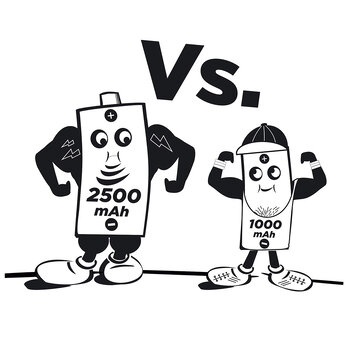
When choosing rechargeable batteries, the main criterion for our customers is capacity, possibly brand, and of course price. It has become established that the higher the capacity of such a battery, the better. Such batteries are also clearly more expensive than potentially weaker/less capacious counterparts. In practice, choosing the most expensive, highest-capacity battery in the series is not always the optimal choice.
The relationship between capacity and lifespan of Ni-MH batteries
Batteries with the highest capacities make maximum use of available technologies, containing as much active material as possible in a single battery. As a result, their production cost is significantly the highest.
However, such a heavily stressed battery has one serious drawback - significantly limited lifespan.
A typical AA 2500 mAh battery usually has 2-4 times shorter lifespan than 2000 mAh cells produced in the same factory.
1000 mAh cells can be used even 2x more times than 2000 mAh cells. During operation, cells like AAA 500 mAh or AA 1000 mAh can turn out to be nearly 10x more durable than the strongest, most capacious cells.
The period of full usability of such low-capacity batteries easily exceeds 10 years.
Do we really need high capacity?
Even disregarding the aspect of excellent lifespan of low-capacity batteries, we do not always need as high a capacity as offered by more expensive counterparts.
Some devices are unable to utilize the full available capacity of batteries - in such devices, a battery with half the capacity does not necessarily have to work significantly shorter.
Devices that have been operating on batteries - remotes, clocks, scales, etc. work for many months between battery replacements - there, using typical high-capacity batteries is pointless (for both economic and ecological reasons). Using cheaper low-capacity batteries can be an ideal solution to replace disposable batteries in such devices - for the user, an additional benefit will be the fact that Ni-MH batteries do not leak.
All devices where the manufacturer factory-installed batteries with much lower capacities, which are assumed to be irregularly, often recharged - especially all solar accessories: rodent repellents, solar lights, other garden accessories, etc., as well as DECT cordless phones/headsets - in such devices, it is usually not worth installing overly capacious batteries, as they may not be optimally charged and may degrade quickly - here, the best idea is always to choose batteries with a similar (preferably slightly higher) capacity than the factory solution.
Summary
As you already know, batteries with relatively low capacities can have many advantages. In many devices, they will be ideal as a replacement for disposable batteries, in others they will perform not much worse, and in some even better than batteries with theoretically 2 times higher capacities.
As if that were not enough, they are very durable - they age very slowly and can be used for over 10 years.
Price? Very favorable - some branded batteries with capacities of 500 mAh for AAA, or 1000 mAh for AA can be obtained at a price similar to disposable batteries available in a typical supermarket!
See the super durable everActive Infinity Line batteries available at the store hurt.com.pl:
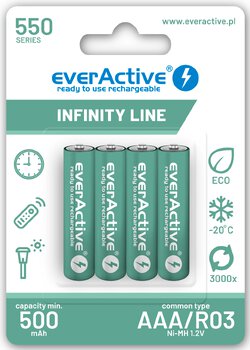
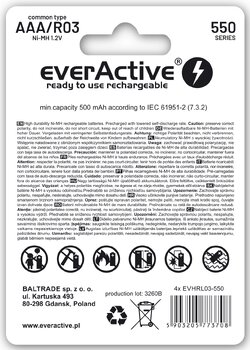
4 x AAA / R03 everActive Ni-MH 550 mAh rechargeable batteries ready to use "Infinity line"
Copying the content of the article or its parts without the consent of a representative of Baltrade sp. z o.o. is prohibited.
-
Jakie są najlepsze baterie do aparatów słuchowych na rynku?
Czy istnieją specjalne baterie przeznaczone do implantów słuchowych?
Jakie są różnice między bateriami Varta Power One a everActive Implant HD?
Czy baterie AA / LR6 są odpowiednie do zastosowania w innych urządzeniach elektronicznych?
Jakie są zalety akumulatorków Ni-MH w porównaniu do tradycyjnych baterii?"2950
1
0-
Jakie są najlepsze baterie do aparatów słuchowych na rynku?
Na to pytanie nie ma jednoznacznej odpowiedzi, dużo zależy od modelu aparatu i rodzaju obciążenia danej baterii.
Jako najkorzystniejsze pod względem jakości do ceny uchodzą everActive Ultrasonic oraz Rayovac.
Czy istnieją specjalne baterie przeznaczone do implantów słuchowych?
Tak, tylko w rozmiarze 675, takie baterie można kupić pod trzema markami Power One Implant Plus, everActive Implant HD, Rayovac Impant Pro+.
W stosunku do standardowych baterii 675 potrafią w krótkim czasie oddać więcej prądu, bez istotnego spadku napięcia na baterii. W przypadku stosowania tych baterii w implantach czy procesorach mowy dużo rzadziej użytkownicy skarżą się na nagłe, nieoczekiwane wskazanie słabej baterii.
Jakie są różnice między bateriami Varta Power One Implant Plus a everActive Implant HD?
Baterie pochodzą od innych producentów, mimo dużej różnicy w cenie na korzyść baterii everActive są porównywalne - oba modele uchodzą za bardzo wydajne przy zastosowaniu w implantach słuchu.
Na pozostałe pytania z łatwością można znaleźć odpowiedzi w innych artykułach na niniejszym blogu.
4010
2
0
-