
- Tips
- technology
- Frequently Asked Questions
- Tests
- mAh capacity
- Rated Capacity
- comparison
- everActive
- Batteries vs rechargeable batteries
- Accumulated energy
- Durability of rechargeable batteries
- Efficiency of rechargeable batteries
- battery voltage
- LR03 AAA
- LR6 AA
- eneloop
- AG13 LR1154 LR44
- CR 2032
- Delta V
- Charge Cycles
- internal resistance
- charge level
- memory effect
- accredited test
- SR44 357
- Hearing Batteries 675
- SR626 377
- Watch Batteries
- Polarity
- Mah
- passivation
- LS 14250
- LS 14500
Passivation in lithium batteries - we explain this interesting and quite common phenomenon.


Have you ever experienced that a freshly inserted new CR2032 lithium battery in the remote control refused to work? Or maybe the device immediately signaled a low charge level despite having a new battery installed? If so, like most people, you probably considered that battery defective and useless.
Or maybe you threw away such a battery? We encourage you to read our post, where you will learn that you may have disposed of a perfectly good battery.
In practically all lithium batteries, after 6-12 months of storage, the effect of apparent increase in internal resistance may occur - the so-called battery passivation.
The battery remains seemingly dormant. This minimizes the self-discharge effect, which ensures very long shelf lives characteristic of this type of battery.
The effect manifests itself with the symptom that the battery has the correct voltage at the terminals, but at the first moment after applying a load, the voltage drops sharply, and the battery delivers much less current than it should. This symptom usually disappears no later than a few minutes after installing the battery in the target device and is completely imperceptible to the user in most devices.
However, there are devices that temporarily, in a pulse, require a significant amount of current. Therefore, after inserting such a dormant battery into a remote control or another wireless transmitter, it may happen that initially the battery does not work as it should. The device may not even start initially.
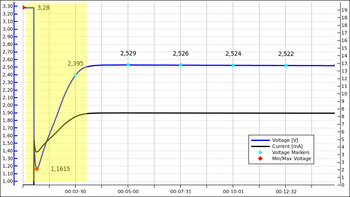
The described phenomenon is well illustrated in the chart below, where the CR2016 battery, completely functional, with high capacity, was connected to a demanding (high for this type of battery) load of 320 Ohm.
Figure. The effect of passivation and awakening of the CR2016 lithium battery.
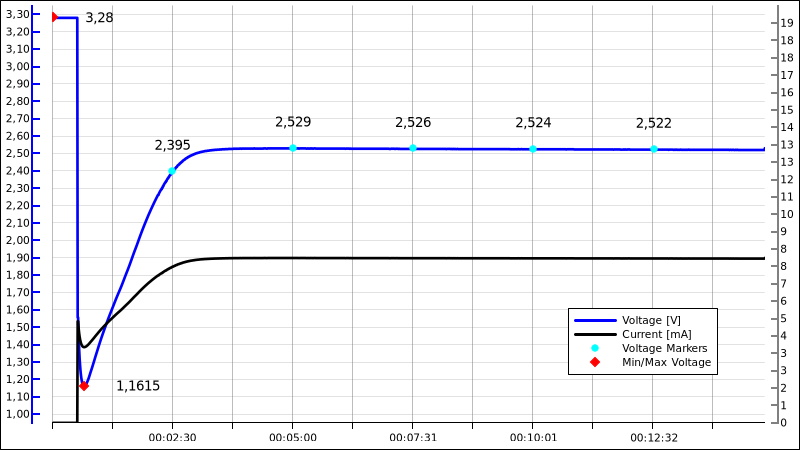
Due to the very large initial voltage drop, the battery may have been hastily considered defective. However, after about 2 minutes, it was completely awakened and continued to operate at nominal performance.
In typical applications, it is usually enough to wait a moment and try to use such a battery normally for a few minutes. The battery will awaken, and the device will work just like with any other good quality battery.
Author: Michał Seredziński
Copying the content of the text or its parts without the consent of a representative of Baltrade sp. z o.o. is prohibited.