
- Tips
- technology
- Frequently Asked Questions
- Tests
- mAh capacity
- Rated Capacity
- comparison
- everActive
- Batteries vs rechargeable batteries
- Accumulated energy
- Durability of rechargeable batteries
- Efficiency of rechargeable batteries
- battery voltage
- LR03 AAA
- LR6 AA
- eneloop
- AG13 LR1154 LR44
- CR 2032
- Delta V
- Charge Cycles
- internal resistance
- charge level
- memory effect
- accredited test
- SR44 357
- Hearing Batteries 675
- SR626 377
- Watch Batteries
- Polarity
- Mah
- passivation
- LS 14250
- LS 14500
For many the best – CR123 Panasonic lithium batteries – disappearing from the market in 2026? Test of a direct replacement.


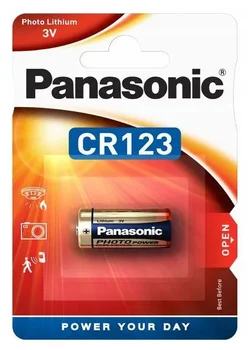
As many of you know, consumer batteries from the Panasonic brand have become difficult to obtain in existing sales channels due to disruptions at the distribution levels by the end of 2025. Therefore, the availability of batteries from this brand in Poland and other EU countries has become uncertain.
There are many battery brands on the market, so finding an alternative or replacement should not be a problem. And indeed, this will be the case for most popular battery sizes. However, there are exceptions...
The Genesis of the Problem
Apart from popular AA batteries or button cells, there is an area where Panasonic batteries have dominated. This is the industry and production sector, as well as the professional segment, which have favored Panasonic's specialized lithium batteries in size CR 123 and to a lesser extent CR 2.
The Panasonic CR123A battery enjoys a very good reputation and an excellent quality-to-price ratio. At first glance, it is not easy to find a direct replacement from another brand. Alternative batteries are either significantly more expensive or not better at all, as has been repeatedly shown by internal tests from our customers.
CR123 - these are old-type batteries, once used in digital cameras - is this not a relic of the past?
Batteries of this type, once popular in the consumer market, known as professional photographic batteries, are still widely used in professional applications: alarm/monitoring/GPS sensors, meters, detectors, small high-power flashlights, as well as a reliable power source for specialized IoT/Smart Home products. They are also used in night vision devices, optical sights, and even some defibrillators and other medical devices. This battery is very popular in DIY projects - a characteristic feature of this battery is its small size, while having a significant energy potential – all this with a very high durability – up to 10 years from the date of production.
The new CR123A battery from everActive – is it worth attention?
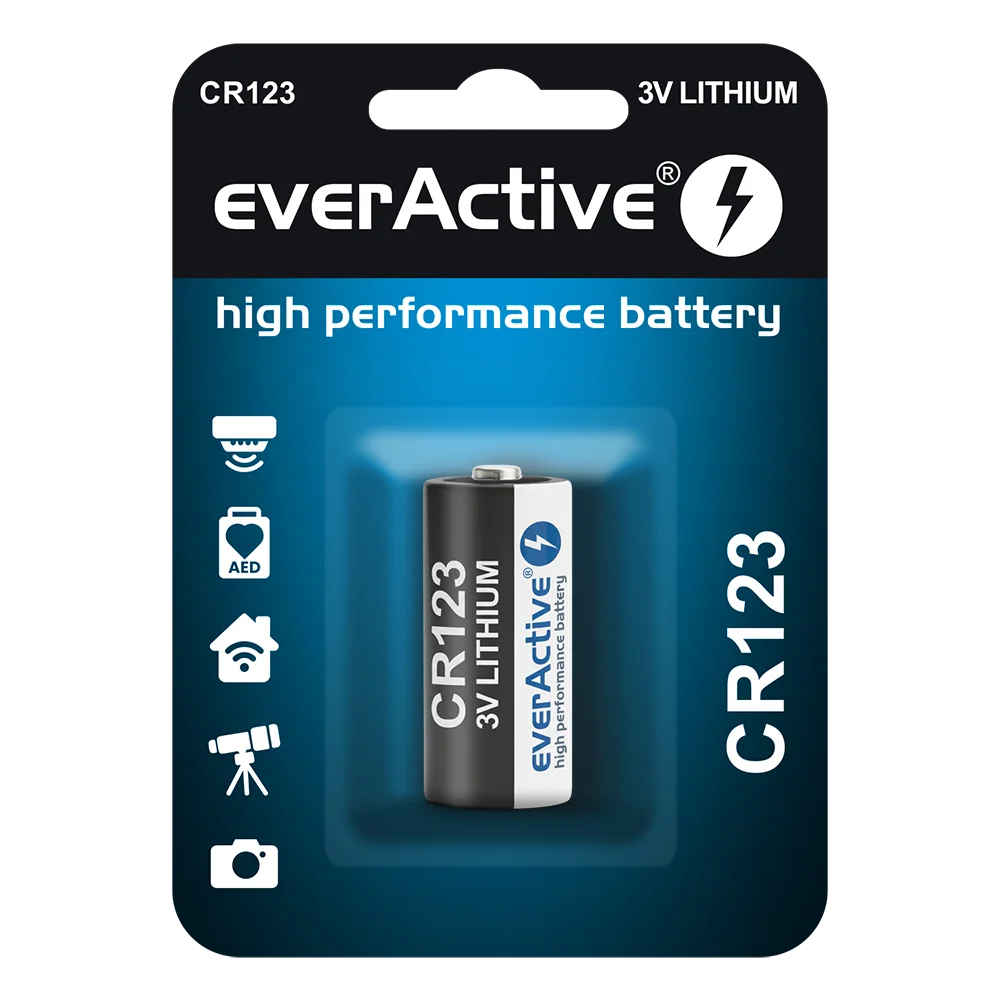
A very competitively priced CR123 battery from everActive has recently become available in our warehouse, which aspires to become the new favorite battery of installers.
Time for Tests
We conducted several comparative tests under various load conditions comparing the new battery to the well-known and liked reference battery from Panasonic. Tests were conducted at room temperature with 30% humidity. The batteries are possibly fresh - curious about the results? - then let's begin.
Test No. 1 - Discharge at 50 mA
This is a test under medium load conditions. The termination voltage is 1.5V. During the test, a resistance test was performed at 30-minute intervals.
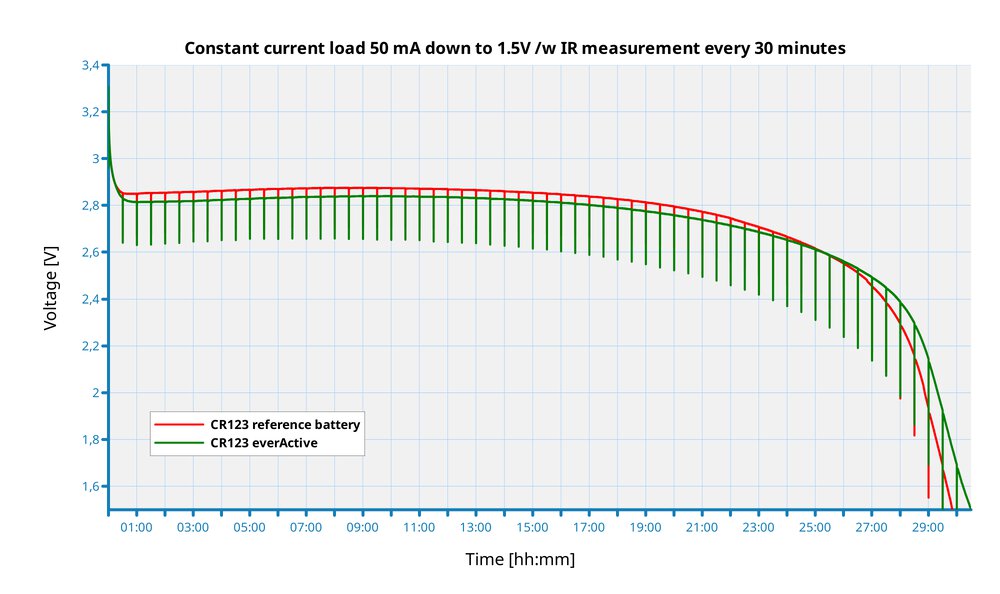
Under such conditions, good quality CR123 batteries should achieve capacities close to nominal – noting that the capacities declared by manufacturers for this battery assume discharging at an even lower current – around 20-30 mA (and more precisely at a resistive load of 100 Ohm).
Nevertheless, the everActive battery performed very well – the capacity from the test is 1557 mAh. It is certain that in various sensors and less demanding devices, the battery will not perform shorter than more expensive alternatives.
Measured capacity:
- everActive battery: 1557 mAh
- reference battery: 1524 mAh
Internal resistance halfway through the discharge process:
- everActive battery: 412 mΩ
- reference battery: 348 mΩ
Stored energy
- everActive battery: 4.19 Wh
- reference battery: 4.16 Wh.
Test No. 2 - Discharge at 1000 mA
This is a test under high load conditions (e.g., simulating load in a flashlight). During the test, a resistance test was performed at 5-minute intervals. The termination voltage is 1.0V.
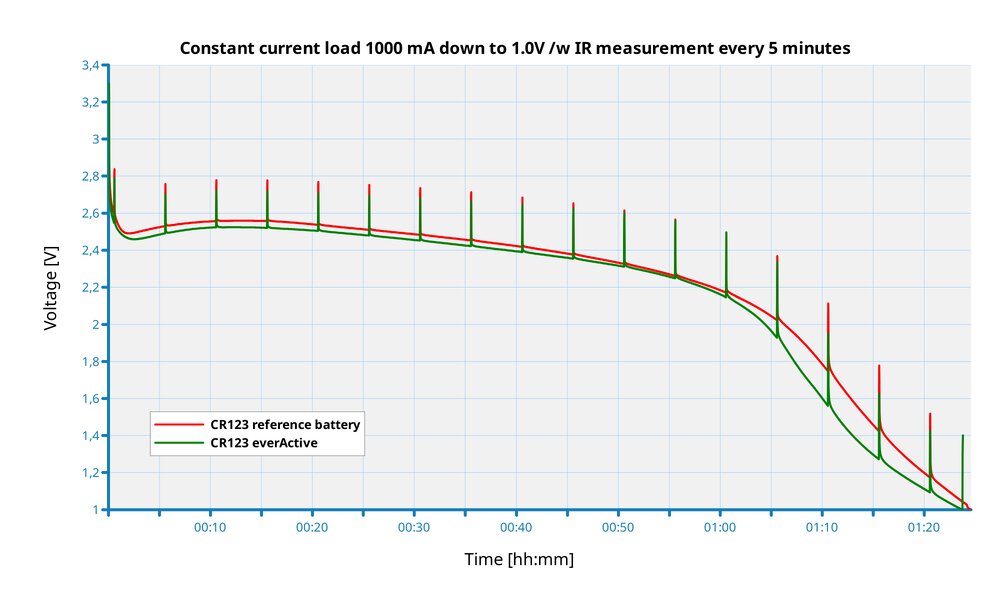
Again, a result “on the edge” despite difficult testing conditions for the battery – comparable to the reference battery.
Measured capacity:
- everActive battery: 1393 mAh
- reference battery: 1406 mAh
Internal resistance halfway through the discharge process:
- everActive battery: 284 mΩ
- reference battery: 296 mΩ
Stored energy:
- everActive battery: 3.03 Wh
- reference battery: 3.11 Wh.
Test No. 3 - Discharge at 900 mA Pulsed
This time the load is pulsed at 900 mA (3s ON / 27s OFF). The termination voltage is 1.55V.
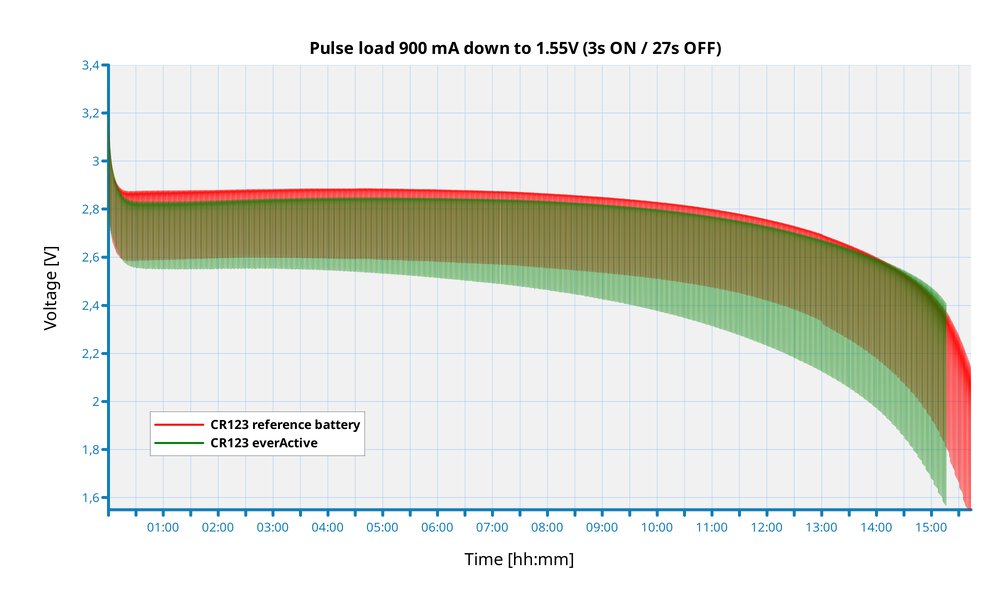
Again similar results, although in the case of the everActive battery, a greater increase in internal resistance during discharge can be observed.
Measured capacity:
- everActive battery: 1399 mAh
- reference battery: 1441 mAh
Internal resistance halfway through the discharge process:
- everActive battery: 403 mΩ
- reference battery: 343 mΩ
Stored energy:
- everActive battery: 3.35 Wh
- reference battery: 3.58 Wh
Number of pulses to voltage 1.55V:
- everActive battery: 1832
- reference battery: 1886.
Test No. 4 - Discharge at 1200 mA Pulsed
This time the load is pulsed at 1200 mA (3s ON / 7s OFF). The termination voltage is 1.3V.
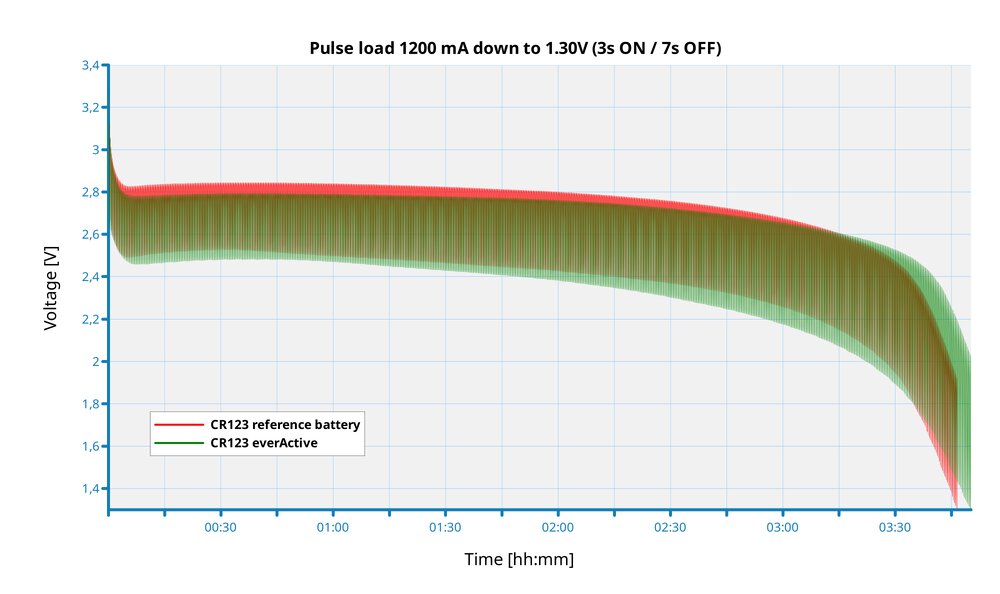
No "surprise" – another comparable result of the everActive battery against the reference battery.
Measured capacity:
- everActive battery: 1394 mAh
- reference battery: 1378 mAh
Internal resistance halfway through the discharge process:
- everActive battery: 313 mΩ
- reference battery: 308 mΩ
Stored energy:
- everActive battery: 3.22 Wh
- reference battery: 3.28 Wh
Number of pulses to voltage 1.3V:
- everActive battery: 1381
- reference battery: 1359
Test No. 5 - Discharge at 1800 mA Pulsed
Demanding load of pulsed nature at 1800 mA (3s ON / 7s OFF). The termination voltage is 1.0V.
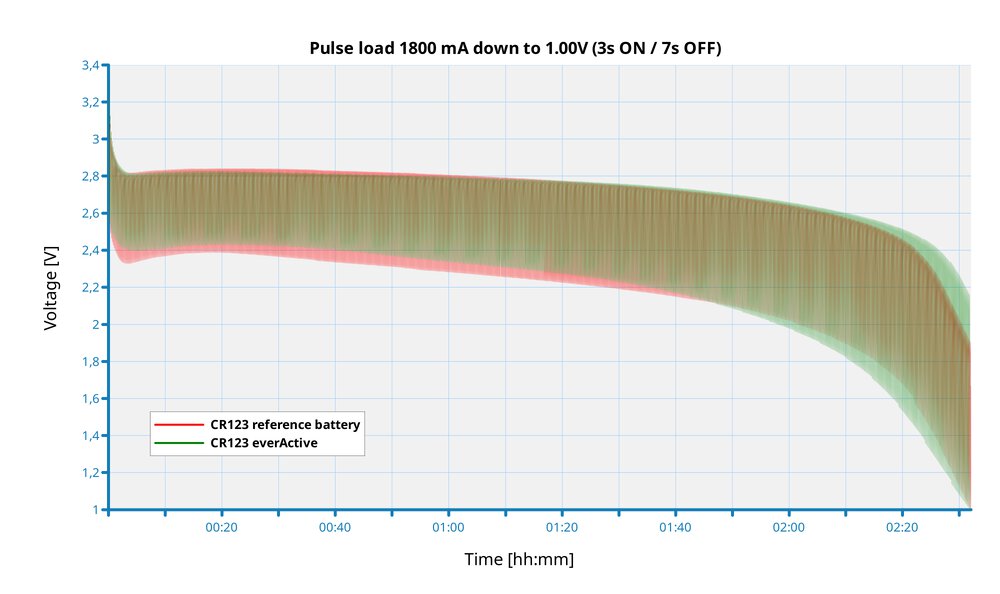
Again extremely close, despite demanding testing conditions.
Measured capacity:
- everActive battery: 1391 mAh
- reference battery: 1392 mAh
Internal resistance halfway through the discharge process:
- everActive battery: 266 mΩ
- reference battery: 302 mΩ
Stored energy:
- everActive battery: 3.05 Wh
- reference battery: 3.04 Wh
Number of pulses to voltage 1.0V:
- everActive battery: 911
- reference battery: 912
Summary
The everActive CR123 (CR 123 A) battery performed very well in direct comparison to the well-known and liked reference battery. The new battery besides very good performance also turned out to be safe – we verified and confirmed the correct operation of the PTC protection, which can effectively protect the battery and device in case of short circuit/overheating/overload, etc.
Focusing on the results of our tests, it cannot be said that this is a better battery, but it is also difficult to unequivocally indicate that it is worse – the batteries are very comparable, to the extent that looking at selected sparse results, it is hard not to get the impression that we are talking about identical batteries – an ideal replacement?
Author: Michał Serediński
Copying the content of the article or its parts without the consent of a representative of Baltrade sp. z o.o. is prohibited.
New batteries available at hurt.com.pl
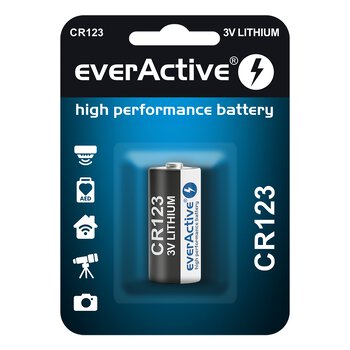
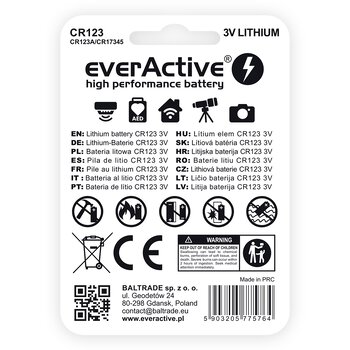
1 x everActive CR123 lithium photo battery
- Height: 34.5 mm
- Diameter: 17 mm
- Weight: 17 g
- Voltage: 3 V
- Capacity: 1500 mAh
- 10-year shelf life
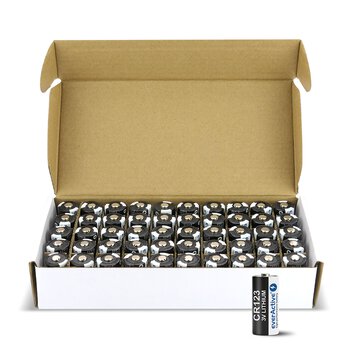
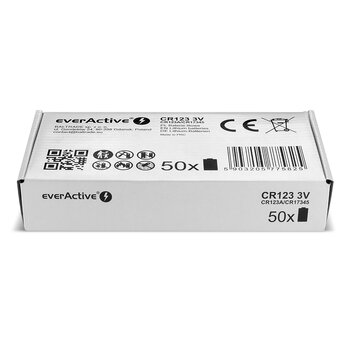
50 x everActive CR123 lithium photo battery
- Height: 34.5 mm
- Diameter: 17 mm
- Weight: 17 g
- Voltage: 3 V
- Capacity: 1500 mAh
- 10-year shelf life
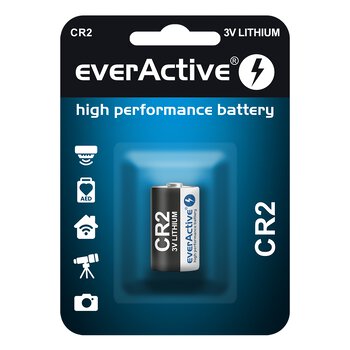
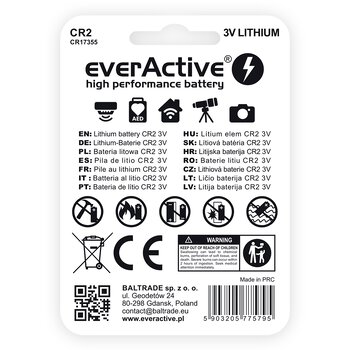
1 x everActive CR2 lithium photo battery
- Height: 27 mm
- Diameter: 15.6 mm
- Weight: 11 g
- Voltage: 3 V
- Capacity: 850 mAh
- 10-year shelf life