
- Tips
- technology
- Frequently Asked Questions
- Tests
- mAh capacity
- Rated Capacity
- comparison
- everActive
- Batteries vs rechargeable batteries
- Accumulated energy
- Durability of rechargeable batteries
- Efficiency of rechargeable batteries
- battery voltage
- LR03 AAA
- LR6 AA
- eneloop
- AG13 LR1154 LR44
- CR 2032
- Delta V
- Charge Cycles
- internal resistance
- charge level
- memory effect
- accredited test
- SR44 357
- Hearing Batteries 675
- SR626 377
- Watch Batteries
- Polarity
- Mah
- passivation
- LS 14250
- LS 14500
Does fast charging harm Ni-MH batteries? How to properly charge nickel-metal hydride batteries?

Among many of our customers, there is still a belief that the slower we charge a given battery, the better it is for its condition and lifespan. Unfortunately, it is very easy to unknowingly damage your batteries. If we charge new AA batteries with a current of around 200-300 mA, we can be quite sure that we are not utilizing their full potential, and we may even damage them. The fundamental issue is what exactly too fast or too slow charging means.
It is understandable that we do not want to lead to too rapid wear of batteries by charging them too quickly.
However, one must be aware of what fast charging actually means. Years ago, there was a trend for 15, 30, 45-minute chargers. Those were indeed fast chargers.
These chargers had a charging current of 2A and more for each installed cell.
Generally, in the case of Ni-MH technology, nothing bad happens to the battery as long as the temperature does not regularly exceed 50 degrees C during charging. This limit was often exceeded in these fast chargers, and the chargers themselves have practically completely disappeared from the market.
The Ni-MH technology is considered to be generally safe, among other things, due to the non-invasive ability to dissipate (transfer) excess supplied energy in the form of heat - as long as the heat is kept in check, there should be no damage to the battery.
So summarizing this thread - for a new 2000 mAh battery, a current of 1A (charging time just over 2h) is not yet excessively high, real problems with heat begin to appear only at values of 1C (where C is the capacity of the battery), that is, 2000mA for a 2000 mAh battery, 2600mA for a 2600 mAh battery, etc.
I already know when we talk about fast charging or high charging current, but I do not understand what causes the problems with slow charging or too low charging current?
Charging a typical Ni-MH battery ends when the voltage on the battery reaches its maximum value (this value may be different for each battery, and even for each charging cycle, as it depends on many factors, such as temperature or charging current), and then begins to slowly drop. The problem is that at a current of 0.1C (e.g., 190 mA for a 1900 mAh battery), this phenomenon will never occur. At 0.2C (380 mA for a 1900 mAh battery), the effect will still be minimal. We will show this below on the appropriate graphs.
After all, on my 1900 mAh battery, the manufacturer clearly states "Standard charge: 190 mA for 16h".
The "standard charge" notation in the form we see on batteries (regardless of the manufacturer) is a requirement of IEC/EN standards - it concerns charging a battery previously discharged to 1.0V at a current of 0.1C for a period of 16h - without any automation, voltage control, etc.
In the age of advanced chargers, this notation/requirement is largely senseless, having nothing to do with real recommendations. However, as a rule, it must be placed on the battery, specifying the conditions under which the manufacturer guarantees achieving the minimum capacity of the battery.
What does the charging characteristic of a battery look like at currents of 0.1C, 0.2C, 0.5C, and 1C? What are the consequences of such charging?
We illustrate this using the example of the everActive Silver Line AA R6 2000 battery, with a minimum capacity of 1900 mAh.
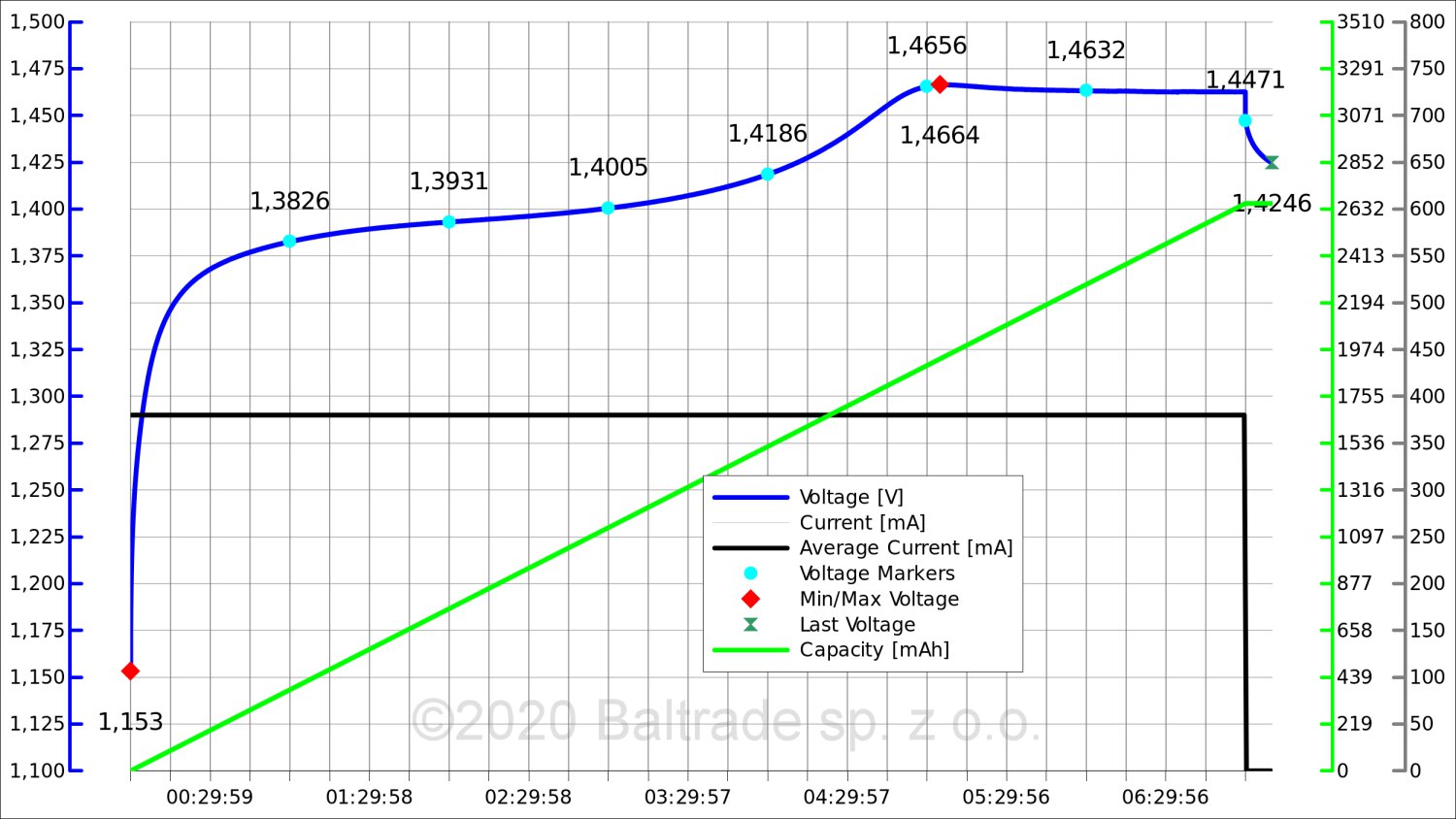
1. Charging at a current of 0.1C, which is 190 mA for a 1900 mAh battery.

It is assumed that at such a low charging current, charging should take about 14-16h. The only determinant of full charge here is time and the fact that the voltage on the battery has been stabilized at some point, although it is still slowly rising.
As can be seen, the voltage on the battery continues to rise even after 16h, despite the fact that the battery has already been fully charged. In such conditions, any automatic charger may have difficulty correctly assessing full charge. As a result, very often the battery is undercharged or overcharged - in the case of regular overcharging, we lead to faster wear of our cells. In the case of regular undercharging, our cell may be affected by the so-called lazy battery effect, and we may have problems fully utilizing its capabilities.

2. Charging at 0.2C, which is 380 mA for a 1900 mAh battery.
The battery was charged in about 6h. In such conditions, a minimal drop in voltage can already be seen at the end of the charging process. As we will show below, however, this change is very small.
The drop in voltage at a current of 0.2C was only 3 mV. Good microprocessor chargers can detect differences of 2-3 mV, and charging in such conditions has a chance to end correctly. However, due to the very small nature of the change (drop) in voltage in the last phase, this method of charging still carries the risk of incorrect assessment of charge by the charger.
If our charger allows us to choose the charging current, then the value of 0.2C should be treated as a minimum.

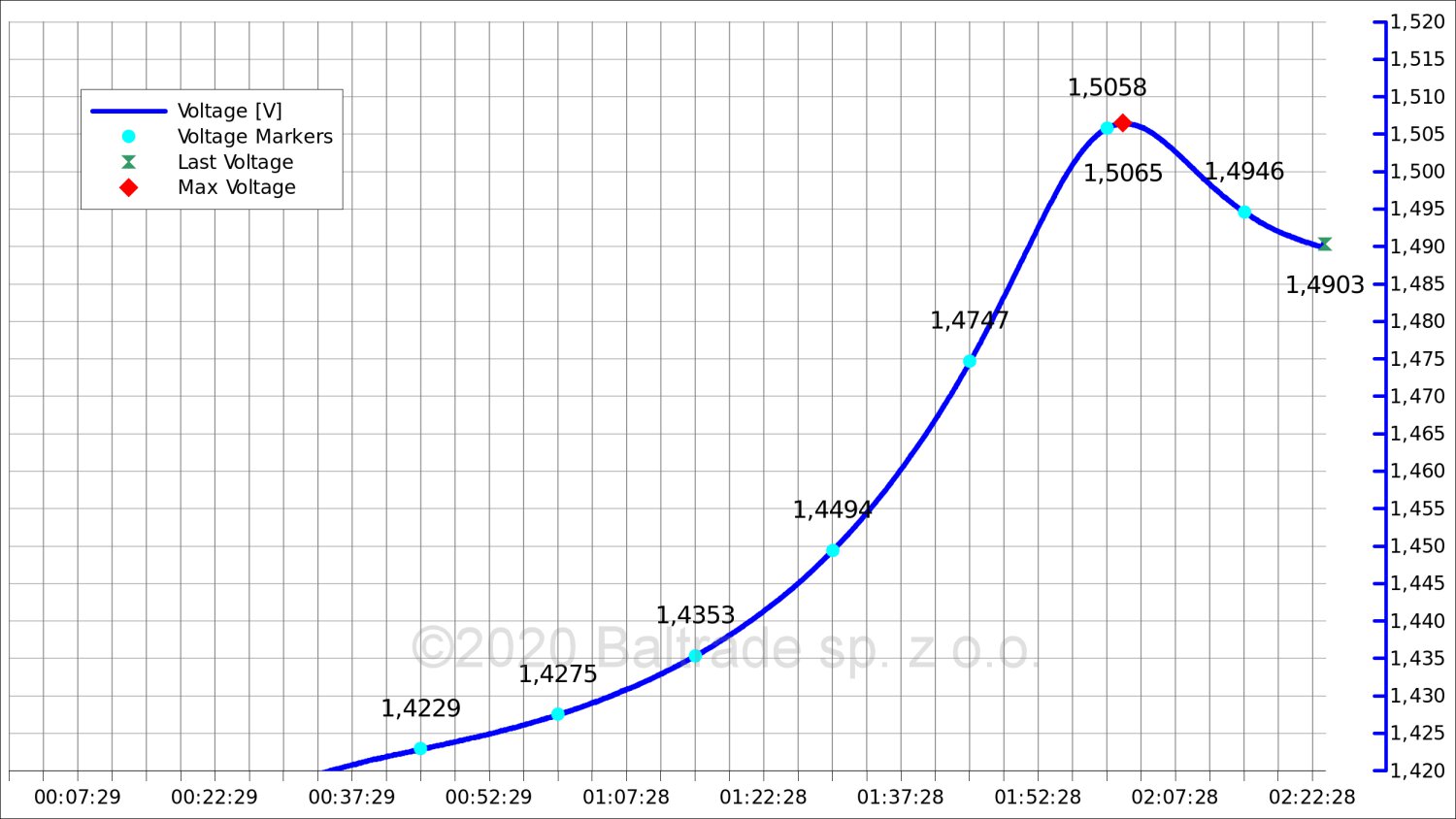
3. Charging at 0.5C, which is 950 mA for a 1900 mAh battery.
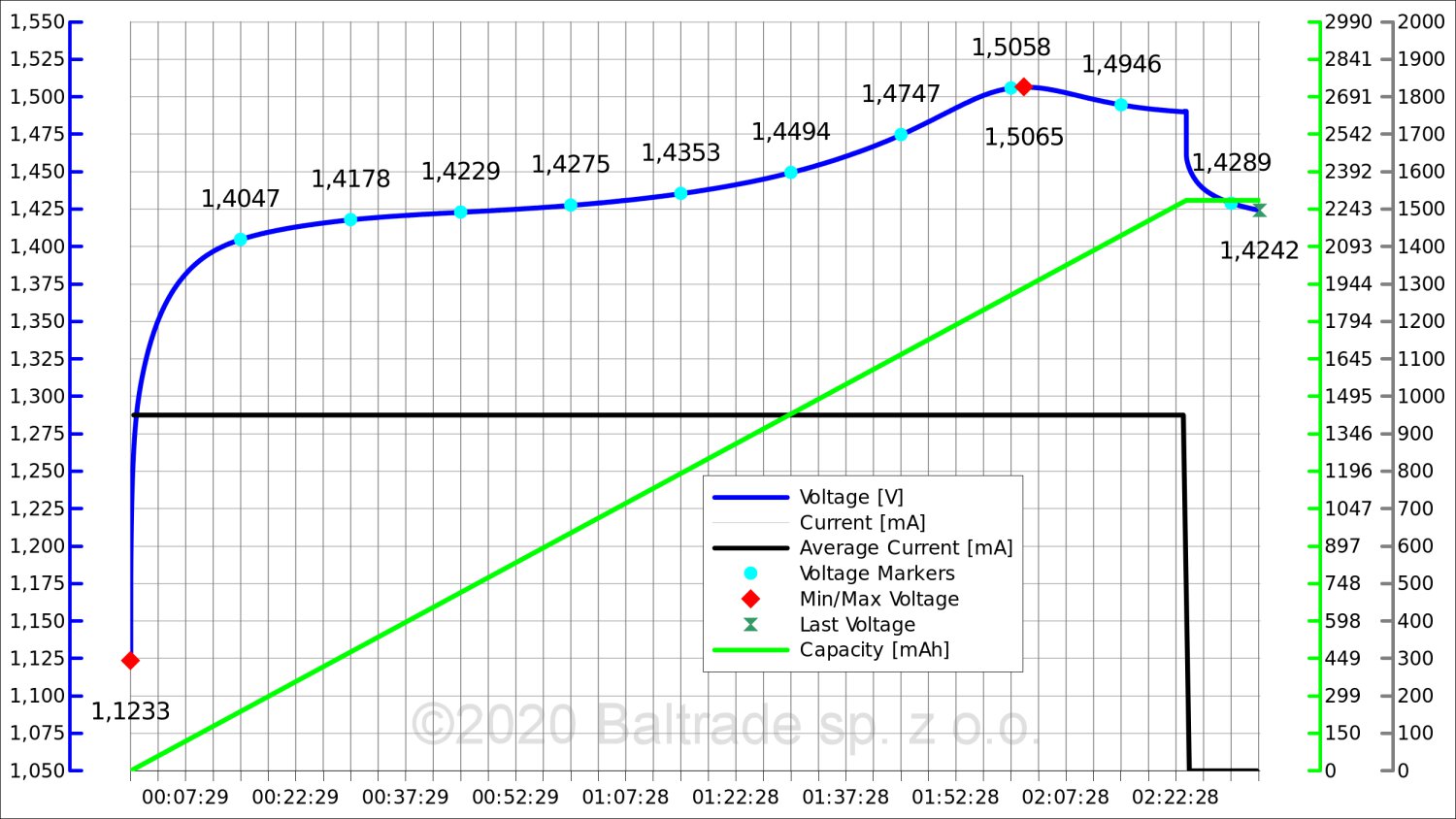
Charging took just over 2h. This time, a quite characteristic voltage hump can already be seen at the end of the charging process. The change is now clearly visible.
The drop in voltage at a current of 0.5C was 15 mV here. Most chargers should no longer have a problem correctly assessing the moment of full charge.
At a charging current of around 1000 mA in compact, popular chargers, however, there may be a thermal problem related to the heat generated by the charger itself. Changes in temperature "from the outside" can effectively disrupt the charging process of the battery, which sometimes also causes it to overheat.
Analyzing the above graphs, we already know why it is often assumed that the optimal charging current is in the range of 0.2-0.5C.
4. Charging at 1C, which is 1900 mA for a 1900 mAh battery.
Charging was completed in just over an hour. The change in voltage is very noticeable, its drop is even steeper. As we can see, the higher the charging current, the easier it is to notice the drop in voltage on the battery at the end of charging.

The drop in voltage this time was close to 20 mV. The difference is relatively large, however, the battery was already noticeably warm at the end of charging.
If we add to this the possible problems with the heating of the charger itself, we may have trouble maintaining a sufficiently low temperature of the cell, which may result in significant overcharging and overheating of the battery.
At currents around 1C, it is often recommended to actively cool the charger or use additional, sensitive temperature sensors.
At a charging current of 1C and higher, it also happens that the battery is slightly undercharged - charging may be prematurely terminated due to a rapid increase in temperature.

In summary, currents around 0.1C (p.1) are often too low to automatically and correctly detect the moment of full charge. Of course, there are chargers on the market that can do this, but when buying the simplest charger, where the manufacturer declares a charging time of 10h or longer, we must be aware of the possible consequences and compromises in the adopted charging algorithm.
Currents of 0.2C-0.5C (p.2,p.3) are considered the most optimal, allowing automatic chargers to correctly assess the moment of full charge of the battery. At these currents, there is also the least risk of overheating the battery.
Currents of 0.5C-1C (p.4) - at these values, the ambient temperature and the temperature of the charger itself during charging are important - any sudden changes in temperature can disrupt the charging process and lead to dangerous overheating of the battery. Such high charging currents will also heat batteries that are already partially worn and exhausted much more.
Currents above 1C - this is what we call too high a charging current. We recommend avoiding regular use of any 15-30 minute chargers. Although these chargers often have additional cooling, they still often have problems with precisely charging batteries and can lead to their faster wear. There is often also a problem with charging partially worn batteries.
Author: Michał Seredziński
Copying the content of the text or its parts without the consent of a representative of Baltrade sp. z o.o. is prohibited.
-
Witam ! Dziękuję serdecznie za obszerne i profesjonalne informacje*Bardzo mi pomogły w przygotowaniu do powrotu, do używania akyumulatorków NiMh*Pozdrawiam !1412
0
0
-
najbardziej zaciekawiło mnie to że 1,9Ah aku przyjął (odczytane z wykresu):
0,1C - 3,1Ah
0,2C - 2,6Ah
0,5C - 2,2Ah
1,0C - 2,2Ah
więc zasadnicze pytanie brzmi dla jakiego prądu rzeczywista ilość zgromadzonej energii była największa?1333
0
0-
W każdym z tych przypadków rzeczywista ilość energii przyjęta przez akumulator była niemal identyczna, choć przy najwyższych prądach ładowania jest minimalnie (o kilka procent) niższa.
Akumulator Ni-MH będzie "przyjmował" tak długo energię jak długo będziemy ją do niego dostarczali. Ta chemia ma tą zaletę, że nadwyżki energii, której nie jest w stanie przyjąć wytraca w formie ciepła - o ile tego ciepła nie ma zbyt dużo, wówczas jest to proces dość bezpieczny, z niewielkim wpływem na żywotność samego ogniwa.
Niemniej zauważona obserwacja jest zgodna z praktyką - ogniwo 1,9Ah przy 0,1C zgodnie z odpowiednią normą IEC/PN-EN ładujemy do 3040 mAh - bez żadnej automatyki, licząc się z tym, że akumulator zostanie przeładowany - jednak z uwagi na niski prąd ładowania, ilość wydzielonego ciepła na akumulatorze będzie niewielka.
Przy 0,2C mamy jeszcze teoretycznie 2 wyjścia - albo ładujemy ogniwo przez ok. 6,5h bez żadnej automatyki - ogniwo 1900 mAh jest wtedy ładowane do ok. 2500 mAh. Tutaj już ilość ciepła będzie istotnie wyższa, mimo mniejszego przeładowania ogniwa.
Dlatego przy prądach 0,2C i wyższych potrzebna jest już zwykle dodatkowa automatyka, gdzie ładowarka stara się możliwie szybko wykryć moment pełnego naładowania ogniwa. Ilość władowanych mAh do pustego akumulatora stanowi zwykle wartość 105-120% jego faktycznej pojemności.
Teraz im wyższy prąd ładowania tym przeładowanie ogniwa liczone w mAh jest zwykle niższe - mimo to temperatura końcowa ładowania będzie wyższa wraz z wyższym prądem ładowania.
Przy prądach rzędu 2C zwykle ładowarka nie jest już w stanie bezpiecznie dostarczyć do akumulatora nawet 100% jego pojemności liczonej w mAh (temperatura jest już wysoka) - i taki akumulator może być niedoładowany.
1344
7
0
-
-
Jak zwykle pełen profesjonalizm. Też mi miło odświeżyć sobie dobrze zaprezentowane wiadomości. Pozdrawiam.1307
4
0
-
Przepięknie opisany temat ładowania niklów, wiedzę na temat ładowania zdobyłem 15 lat temu, przypadkowo natrafiłem na tą stronę zobaczyłem 2 wykresy i przeczytałem całość w celu "odświeżenia". Używam liitokali 600 do przeróżnych ogniw litowych i niklów, ale nigdy bym nie wpadł na pomysł ładować niklowego prądem 1C ( 2 ampery) o.O przecież ładowarka go za szybko odetnie i będzie tylko w 3/4 naładowany swojej całej pojemności. Jeżeli już ktoś ma dany sprzęt na baterie AA lub AAA czy to lampa błyskowa czy to pilot, zegar, pad, diskman, postanowił używać akumulatorków niklowych, to niech nie mówi że "NIE MA CZASU" na ładowanie prądem 250-500 mA :) teraz 99% akumulatorków AA ma pojemność 2500 mAh, przyczyniając się do wzoru prądu 0,1C to ładowanie wynosi 250mA i takie też zalecam każdemu stosować w celu naładowania w pełni swojego aku, tzw. prąd dziesięciogodzinny, a w najgorszym przypadku używać 500mA.1246
4
4
-
Panie Michale, to bardzo dobry artykuł wyjaśniający jak powinno się ładować akumulatory niklowo wodorkowe i niklowo kadmowe. Szkoda, że taka rzetelna wiedza nie jest przekazywana powszechnie. I bez głupich docinków jak na elektrodzie, gdzie 75% wątku to jałowa dyskusja, kpiny i kłótnie.1130
19
0
-
Prosto, jasno i na temat. Brawo.512
12
1