
- Tips
- technology
- Frequently Asked Questions
- Tests
- mAh capacity
- Rated Capacity
- comparison
- everActive
- Batteries vs rechargeable batteries
- Accumulated energy
- Durability of rechargeable batteries
- Efficiency of rechargeable batteries
- battery voltage
- LR03 AAA
- LR6 AA
- eneloop
- AG13 LR1154 LR44
- CR 2032
- Delta V
- Charge Cycles
- internal resistance
- charge level
- memory effect
- accredited test
- SR44 357
- Hearing Batteries 675
- SR626 377
- Watch Batteries
- Polarity
- Mah
- passivation
- LS 14250
- LS 14500
Zinc-air batteries for hearing aids - what are they, how to take care of them, what are they better at?


Principle of operation
Zinc-air batteries are unique in their construction. The name itself indicates that air plays a special role in them. It is worth knowing what this technology is about, and consequently, how to take care of such batteries and what their lifespan is. From this article, you will learn, among other things, what affects the shortening of the battery's operating time and how to store them.Return to: List of articles on hearing aid batteries

The battery is covered with a sticker, the removal of which activates the battery. The sticker protects against battery drying out, and after its removal, gradual discharging occurs. The sticker covers the holes that allow air to flow into the battery. Air plays an essential role in the production of molecules on the surface of the cathode (the porous membrane inside the battery). The produced molecules migrate to the anode in the form of zinc gel/powder. As a result of subsequent reactions, electrons are released, which are already in motion as electrical energy. The current generated can power the device.
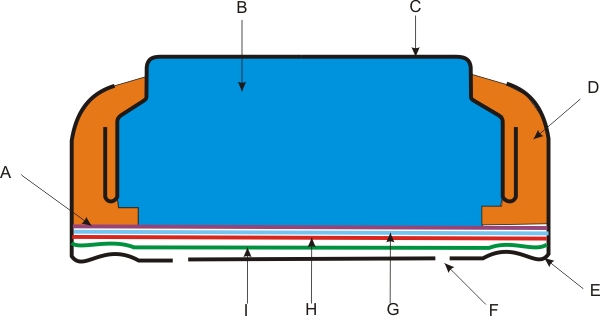
A - separator, B - zinc gel/powder with electrolyte, C - anode casing, D - insulator, E - cathode casing, F - air holes, G - cathode catalyst, H - air distribution coating, I - semi-permeable membrane
Since air is drawn from the environment, it has become possible to reduce the size of the battery while maintaining high efficiency. Hearing aids and implants require a relatively large amount of energy (more than, for example, watches that use batteries of similar sizes), so it is precisely there that zinc-air batteries have found their application. If you are interested in additional aspects of electrochemistry, we are here to help :)
Lifetime of zinc-air hearing aid batteries
Of course, there is no simple answer to what the lifetime of a zinc-air battery is. However, it is certain that they are much more efficient than batteries that have the cathode inside a "button" (air is not present), which means there is significantly less zinc in them. How long the battery will last primarily depends on the nature and intensity of its use, including the level of hearing loss. Amplifying sound to a greater value requires using larger amounts of energy. The size of the battery also matters. Large batteries (size 675) will last longer than smaller batteries (size 10). In conducted studies, lifetimes for size 10 batteries were obtained at up to 10 days. For size 312, it was up to 12 days. For size 13, it was up to 14 days. For size 675, it was even up to 20 days (1). Batteries have a capacity ranging from 90-105 mAh for size 10 to 650 mAh for size 675 (see: Replacement table).
Important!
- Zinc-air batteries are sensitive to environmental conditions. A drop in ambient temperature will shorten the battery life. People working outside in winter should keep this in mind.
- Increased altitude above sea level also means a decrease in oxygen content in the air. Therefore, if you are in the mountains, your battery may work shorter.
Also remember:
- After removing the membrane, allow the zinc-air battery to aerate freely (wait about a minute before inserting it into the device).
- When programming the device, use fresh and efficient batteries, as the most energy is consumed in these processes.
- Store batteries at room temperature.
- Store batteries in their original packaging. Do not let them touch metal objects.
- Do not allow children to play with batteries.
Other facts related to hearing aid batteries:
- Anode: powdered zinc
- Cathode: oxygen (O2)
- Electrolyte: potassium hydroxide (KOH)
- Applications: hearing aids, pagers, electric vehicles
Zinc-air batteries are alkaline batteries (due to the electrolyte used). This is a very interesting type of battery, even if we do not take into account the question "how can we use air as an electrode?" (strictly speaking, oxygen is supplied to the cathode through a hole in the battery and reduced on the surface of carbon).
Many electrochemical systems use metal oxide and zinc. The metal oxide is reduced, zinc is oxidized, creating a potential difference. This is how the old type of battery used in hearing aids worked - batteries based on mercury oxide and zinc (mercury batteries are currently phased out). If we remove the metal oxide from them, we can double the capacity of the battery - but where to get the oxygen then? Well, from the air!
The electrolyte in zinc-air batteries is a 20-40% (weight ratio) solution of alkaline hydroxide in water. One of the disadvantages of such a solution is that such hydroxides are hygroscopic - they absorb or release water to the environment, depending on humidity. Both too high and too low humidity negatively affects the battery's lifespan (selective membranes are a solution here).
Since the battery "does not contain" a cathode (or rather, the weight of the cathode does not count in the battery's mass), the energy density per unit mass in zinc-air batteries can achieve high values - between 400-500 Wh/kg (for comparison - 99-123 Wh/kg for a HgO cathode). Unfortunately, the energy density per unit volume remains low.
The shelf life of zinc-carbon batteries, before they are exposed to air, is about 4-5 years. After activation, their operating time is not very long, even if they are not used. For these reasons (as well as due to the high energy density per unit mass), zinc-air batteries are used to power hearing aids.
A fun fact for little chemists ;-) How to make a zinc-air battery yourself (in English). Remember to take precautions :):
(1) Rule, A., and Kouba, K. (2013, December). Rayovac hearing aid batteries – important things to know to ensure patient satisfaction. AudiologyOnline, Article 12293.
Popular hearing aid batteries at hurt.com.pl
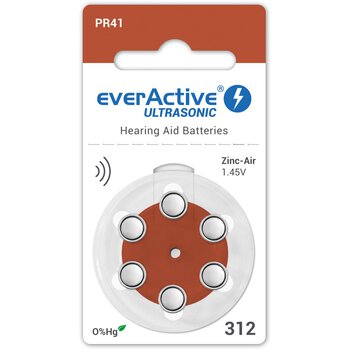
30 x everActive ULTRASONIC 312 hearing aid batteries
Batteries 312 / PR41
- reliable zinc-air batteries for hearing aids
- voltage: 1.45V
- environmentally friendly batteries - mercury-free (0% Hg)
- expiration date: min. 2029
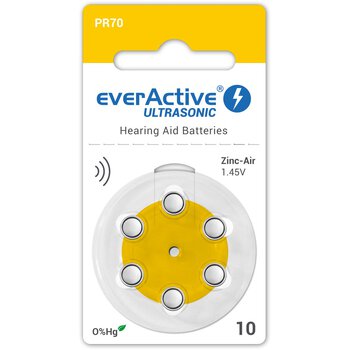
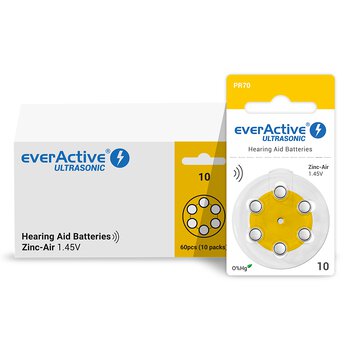
30 x everActive ULTRASONIC 10 hearing aid batteries
- reliable zinc-air batteries for hearing aids
- voltage: 1.45V
- environmentally friendly batteries - mercury-free (0% Hg)
- expiration date: min. 2029


30 x everActive ULTRASONIC 13 hearing aid batteries
- reliable zinc-air batteries for hearing aids
- voltage: 1.45V
- environmentally friendly batteries - mercury-free (0% Hg)
- expiration date: min. 2029
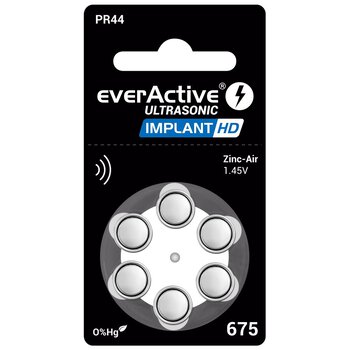
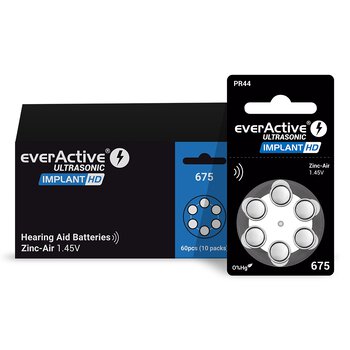
30 x everActive ULTRASONIC IMPLANT HD 675 hearing aid batteries
- reinforced, high-current version of battery 675 with increased performance
- dedicated to cochlear implants and speech processors
- voltage: 1.45V
- environmentally friendly batteries - mercury-free (0% Hg)
- expiration date: min. 2029
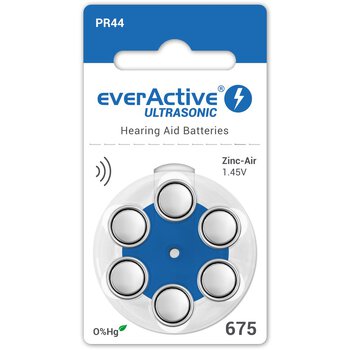
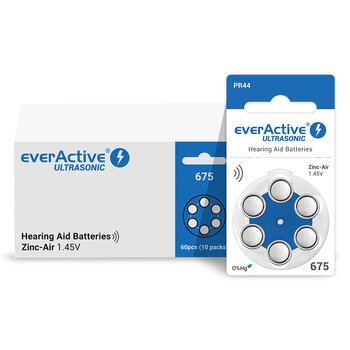
30 x everActive ULTRASONIC 675 hearing aid batteries
- reliable zinc-air batteries for hearing aids
- voltage: 1.45V
- environmentally friendly batteries - mercury-free (0% Hg)
- expiration date: min. 2029
-
Świetna obsługa i doskonałe doradztwo963
0
0
-
bardzo dobrze wyjaśnione, dlaczego bateria na taką samą żywotność (po włożeniu do aparatu) "bez względu" czy aparat jest użytkowany czy tez nie472
3
0
-
Świat się szybko zmienia , powstają nowe technologie wdrażane w nasze życie a często nic o nich nie wiemy a nawet często trudno znaleźć na ich temat jakąś informację, dlatego wdzięczny jestem i dziękuję ludziom którzy poświęcili swój czas aby opisać i przybliżyć innym "ciekawskim" poznanie tego nowego świata.52
4
0