
- Tips
- technology
- Frequently Asked Questions
- Tests
- mAh capacity
- Rated Capacity
- comparison
- everActive
- Batteries vs rechargeable batteries
- Accumulated energy
- Durability of rechargeable batteries
- Efficiency of rechargeable batteries
- battery voltage
- LR03 AAA
- LR6 AA
- eneloop
- AG13 LR1154 LR44
- CR 2032
- Delta V
- Charge Cycles
- internal resistance
- charge level
- memory effect
- accredited test
- SR44 357
- Hearing Batteries 675
- SR626 377
- Watch Batteries
- Polarity
- Mah
- passivation
- LS 14250
- LS 14500
The history of the battery
2019-06-19
21


31
6
The term "battery" was first used in 1748 by Benjamin Franklin to describe a charged glass plate. In the years 1780-1786, Luigi Galvani demonstrated what we now understand as the foundation of knowledge about electricity and electrical impulses, which was the basis for later research by inventors such as Volta. A little later, the physics professor in Como, Italy, Alessandro Volta, who lived from 1745 to 1827, conducted experiments with electricity ...
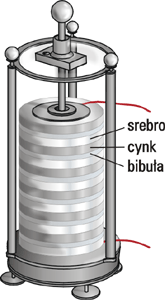
The research was based on the achievements of his friend, Luigi Galvani, who observed that the leg muscles of a dead frog contract when touched by two different metals... Galvani believed that this was the effect of "animal electricity" in the muscles, while Volta assumed that the metals generate current (and the muscles only detect it), which led him to the correct explanation of the concept of an electric circuit. The experiments of Dr. Galvani sparked the curiosity of his compatriot Alessandro Volta, who consequently built the "pile." Volta's original cell (pile) is a vertical column of coins of two kinds (fig. 1), arranged alternately and separated (every other one) by paper moistened in salt water, up to a hundred such pairs. At the exhibition in Paris in 1800, Volta demonstrated both the pile and a series of cells with two plates immersed in acid. Volta wrote, "In the case of two different metals, it is possible that one of them absorbs the electric fluid from the wet body and the other gives it off, thus causing a state of imbalance, or the flow of current."
Copyright © Baltrade
21
31
6
Add a comment