
- Tips
- technology
- Frequently Asked Questions
- Tests
- mAh capacity
- Rated Capacity
- comparison
- everActive
- Batteries vs rechargeable batteries
- Accumulated energy
- Durability of rechargeable batteries
- Efficiency of rechargeable batteries
- battery voltage
- LR03 AAA
- LR6 AA
- eneloop
- AG13 LR1154 LR44
- CR 2032
- Delta V
- Charge Cycles
- internal resistance
- charge level
- memory effect
- accredited test
- SR44 357
- Hearing Batteries 675
- SR626 377
- Watch Batteries
- Polarity
- Mah
- passivation
- LS 14250
- LS 14500
How to understand the different mAh capacity values in the specification of a battery or accumulator?


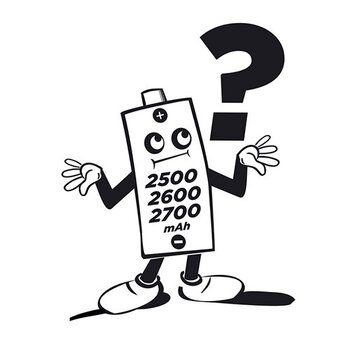
It often happens that when analyzing the technical data of a battery we are interested in, we see, for example, 2 different capacity values expressed in milliampere-hours - mAh. Where do these differences come from? What is typical capacity, minimum, maximum, nominal, rated?
That the usable capacity may vary depending on the application, especially in the case of disposable batteries, we have described earlier.
In conclusion, it can be stated that in the case of disposable alkaline batteries, it would not be unusual for the batteries to have, for example, 3 capacity values in mAh – for low loads, e.g. 5 mA, moderate loads e.g. 100 mA, or high loads – e.g. 1000 mA. The capacity value given at the lowest load would often be several times higher than that obtained at the highest load – this is completely normal for this type of battery.
Another specific case is power banks, where we explained, why the capacity of built-in batteries will always be different (significantly higher) than the usable capacity from the USB output.
However, there may be some doubts about providing two capacity values, e.g. for Ni-MH AA/AAA batteries, or Li-ion 18650, 21700, etc. These batteries behave consistently in typical applications and achieve similar capacities under low as well as moderate loads.
Nevertheless, many manufacturers still use the concepts of minimum, typical, maximum, and designed capacity.
1. Typical / minimum / rated capacity of a battery or accumulator in mAh
This term currently means the capacity value given in accordance with the provisions of EU Regulation 1103/2010, which came into force on 30.05.2012. In short, it means the obtained capacity result according to a specific procedure, technical standard PN/EN/IEC.
According to this standard, one binding capacity should primarily be indicated on the accumulator.
In the case of Ni-MH batteries, the standard assumes discharging a freshly produced (not older than 2 months) accumulator with a current constituting 20% (0.2C) of its capacity value to a voltage level of 1.0V. In the entire test group, production batch, pieces with a lower capacity than declared are practically unacceptable.
The presented result can generally be compared between different accumulators (from different manufacturers) of the same capacity – as we have certainty that the test conditions were almost identical for them.
The formal conditions of such tests are precisely defined, which is why all reputable accumulator manufacturers, to ensure that all batteries meet minimum requirements, produce their batteries with an appropriate capacity reserve – at least 3-5% – these higher values can be called maximum or designed capacities.
Currently, there is an obligation to provide minimum/typical/rated capacity for almost all accumulators – this should be the only value with the unit mAh/Ah written directly on the cell.
minimum capacity=typical capacity=rated capacity=nominal capacity
If, in addition to the indicated capacity value in mAh, we have other values on the battery or its packaging, it may only be the name of the series or precisely the maximum designed capacity of such an accumulator.
2. Maximum / designed capacity of a battery or accumulator in mAh
For reputable / serious manufacturers, this is still a real value, achievable by the user. Above all, as we have written, it is not unusual to produce accumulators with a certain technological reserve – thanks to this, a large part of the accumulators even in a formally standardized test will achieve values higher than the minimum.
Before the provisions of EU Regulation 1103/2010 came into force, there was no formal obligation to provide capacity in a strictly defined manner on the market. It was possible, for example, to discharge the accumulator with a lower current, to a lower voltage, or at a higher ambient temperature – all of this influenced the possibility of achieving higher capacity results.
Sometimes the maximum capacity value may be misused and have nothing to do with reality – if, for example, we find a 18650 type battery on the market with a capacity of 10000 mAh or 12000 mAh, where at the time of writing this article the technological limit is about 3500 mAh, we can be sure that we are dealing with a counterfeit or fraud.
Ultimately, interpreting capacity values expressed in milliampere-hours mAh, let us remember a few rules:
- in the case of disposable batteries, this is a very approximate value and has no comparative value,
- in the case of accumulators, if we want to maintain a comparative value between different batteries from different manufacturers, pay attention to minimum/typical/rated capacities – only these can be safely compared,
- designed, maximum capacities are usually still real values that we can count on during the use of a given accumulator/battery – these are usually values slightly higher than minimum/typical values, and so, for example, buying an accumulator with a designed capacity of 1000 mAh, and minimum/typical 950 mAh, we can assume that the vast majority of accumulators will achieve capacities in the range of 950-1000 mAh, with a few exceptions exceeding this range,
- when we find accumulators with seemingly unbeatable, very high capacity and at the same time low price, we check their exact technical data, whether the typical/minimal capacity is provided in accordance with the regulations – the appropriate standard PN/EN/IEC.
Copying the content of the article or its parts without the consent of a representative of Baltrade sp. z o.o. is prohibited.