
- Tips
- technology
- Frequently Asked Questions
- Tests
- mAh capacity
- Rated Capacity
- comparison
- everActive
- Batteries vs rechargeable batteries
- Accumulated energy
- Durability of rechargeable batteries
- Efficiency of rechargeable batteries
- battery voltage
- LR03 AAA
- LR6 AA
- eneloop
- AG13 LR1154 LR44
- CR 2032
- Delta V
- Charge Cycles
- internal resistance
- charge level
- memory effect
- accredited test
- SR44 357
- Hearing Batteries 675
- SR626 377
- Watch Batteries
- Polarity
- Mah
- passivation
- LS 14250
- LS 14500
How to deal with batteries and LED bulbs? An eco-friendly way to power your devices.


The world is increasingly aware of the negative impact of waste on our environment. In recent months, you may have heard about the announcement of the withdrawal from the sale of traditional batteries by one of the largest retail chains. As an alternative, we are increasingly using rechargeable batteries that allow for multiple charging. The attitude towards disposable batteries is a consequence of the use of various types of heavy metals in their production (especially in older batteries): lead, mercury, cadmium. For this reason, used batteries require special treatment after use.
Waste batteries and electronic equipment
Remember! Used batteries and accumulators should not be thrown into the municipal waste bin!
After using them, dispose of them in a special container marked "Used batteries". You can find it at Baltrade in Gdańsk at 24 Geodetów Street, as well as in schools, offices, offices and gas stations
One silver button battery can contaminate several hundred liters of water! Therefore, dispose of used batteries and accumulators in special containers!
The ban on throwing batteries into the municipal garbage can is indicated by the crossed-out container sign placed on the batteries.

All batteries and accumulators that contain hazardous metals must additionally be marked as appropriate:
symbol Cd, if they contain more than 0,002% cadmium by weight
symbol Pb, if they contain more than 0,004% lead by weight
Hg symbol if they contain more than 0.0005% mercury by weight
Consequences of improper disposal of batteries and accumulators
In Poland, about 130 thousand tons of batteries and accumulators are placed on the market annually (Report of the Chief Inspectorate of Environmental Protection: https://www.gios.gov.pl/images/dokumenty/raporty/Raport-baterie.pdf). The development of wireless technologies and electric vehicles increases the demand for portable power sources. While we, as consumers, have become accustomed to the proper disposal of car batteries, we still have a problem with following the rules for dealing with used batteries and rechargeable batteries of smaller sizes. Remember that the content of heavy metals in some types of batteries can have a strong negative impact on the surrounding environment.
Improperly disposed of batteries contribute to water and air pollution
Discarded batteries are subjected to the influence of weather conditions and over time they corrode and become unsealed. The chemicals in them can then penetrate the soil and contaminate groundwater and surface water. Let's imagine that every year we use several thousand tons of small batteries and accumulators. Their potential impact on the environment is therefore significant.
It should be added that some types of batteries and rechargeable batteries, such as those containing lithium, can be unstable and can cause landfill fires under improper disposal conditions. As a result, toxic substances can be released into the air.
Choose rechargeable batteries
One battery, can be charged up to 2000 times. Its use therefore makes it possible to significantly reduce hazardous waste in the form of disposable batteries.
Recently, modern rechargeable batteries have been created that combine the advantages of alkaline batteries and capacious rechargeable batteries. New generation rechargeable batteries can be used as replacements for ordinary batteries (ready to use right away) in most devices (e.g. remote controls, alarm clocks, portable radios, mp3/mp4 players, flashlights, etc.). Examples of the latest generation of cells are the Panasonic Eneloop MCCE series rechargeable batteries, which can be charged up to 2100 times! We also recommend everActive rechargeable batteries and other leading manufacturers: Energizer Extreme, Duracell Stays Charged, GP Recyko and Varta Ready2Use.
Rechargeable batteries save the environment and money!
Some devices require a high voltage of 1.5V for the entire time of use. In such situations, as an alternative to traditional Ni-MH batteries, new lithium-ion batteries can be used, which are characterized by a voltage of 1.5V and a relatively constant discharge characteristic.
We encourage you to read our articles describing the differences between batteries and rechargeable batteries and indicating the proper way to use rechargeable batteries:
- How to use nickel-metal hydride batteries correctly?
- Have you been doing it wrong all your life? - How to properly install batteries and rechargeable batteries?
- What are the differences between a 1.5V battery and a 1.2V battery? Are there really differences in tension?
- R6 (AA) Ni-MH 1.2V battery? Or maybe a 1.5V alkaline battery? Or maybe it could be both
e? 1.5V Li-ion batteries - a revolution in powering devices is coming
and other articles:
- Batteries and rechargeable batteries - the choice depends on the device!
- Why do fresh Ni-MH rechargeable batteries not work in my device or work much worse than disposable batteries?
- In which devices can we effectively use AA and AAA 1.2V batteries?
- Facts and myths about charging Ni-MH batteries
- How long to charge rechargeable batteries and other rules for using Ni-MH rechargeable batteries
- How to properly charge nickel-metal hydride batteries?
- Is it worth discharging Ni-MH batteries before each charge?
Examples of ecological rechargeable batteries:
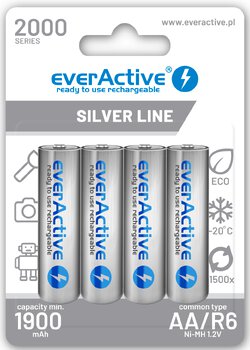
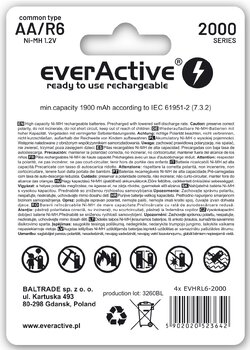
4 x AA / R6 everActive Ni-MH 2000 mAh rechargeable batteries ready to use "Silver line"
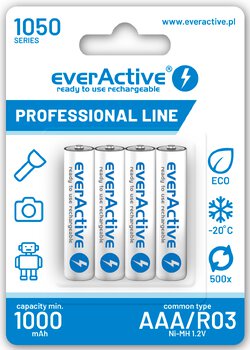
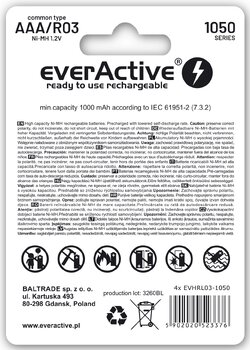
4 x AAA / R03 everActive Ni-MH 1050 mAh rechargeable batteries ready to use "Professional line"
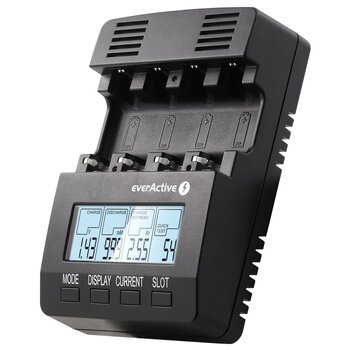
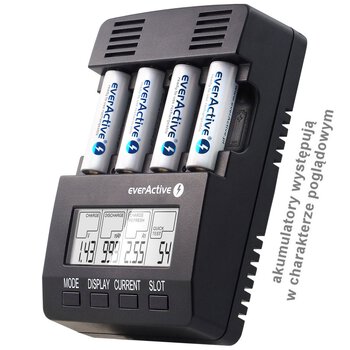
Ni-MH rechargeable battery charger everActive NC-3000
refreshing, maintenance, and conditioning functions for batteries,
How to deal with other e-waste?
E-waste - Waste Electrical and Electronic Equipment, commonly referred to as WEEE is all broken and unnecessary electrical and electronic equipment, powered by electricity from the mains or batteries, such as:
- consumer electronics (m.in. TV sets, players, cameras, radios, mp3, tuners), household appliances (m.in. hi-fi equipment, sound amplifiers), electronic devices
- computers, printers, monitors
- ICT and telecommunications equipment
- Electric and electronic tools
- Toys
- washing machines, refrigerators
- medical instruments (blood pressure monitors, inhalers)
- fluorescent lamps, LED bulbs
- Flashlight
- Charger
- monitoring and control instruments.
E-waste should be collected selectively, then subjected to the processes of recovery, recycling and neutralization of poisonous substances. The products obtained in this way are transferred to processing plants, so that they can be used for the production of new items, e.g. tools or new electronics and household appliances.
The ban on throwing electronic waste into the garbage can is indicated by the crossed-out container sign, placed on electrical and electronic devices.
There are e-waste collection points in every municipality. Selected electronic waste, such as LED bulbs and fluorescent lamps, can be handed in at collection points organized in DIY stores.
E-waste can also be returned free of charge in the store when buying new equipment of the same type, e.g. you can give away the old charger when buying a new one. You can do the same with other e-waste. All you have to do is bring them to the store where you buy your new equipment.
Eco-friendly LED bulbs:
Also watch our presentation: